
WooCommerce Statistics (2026): Is the Platform Actually DYING?

By :
Jaclyn Donaldson
February 10, 2026

WooCommerce powers roughly 33.4% of all ecommerce websites globally, making it the most used online store platform in 2026.
With over 4.5 million live stores and around 30,000 daily plugin downloads, the numbers speak for themselves.
For store owners, developers, and digital marketers, knowing the latest WooCommerce statistics helps shape better decisions and strategies.
From market share and revenue benchmarks to mobile commerce trends and plugin usage, these fresh 2026 figures reveal exactly where the platform stands today and where it’s heading next.
Global WooCommerce Market Share Overview
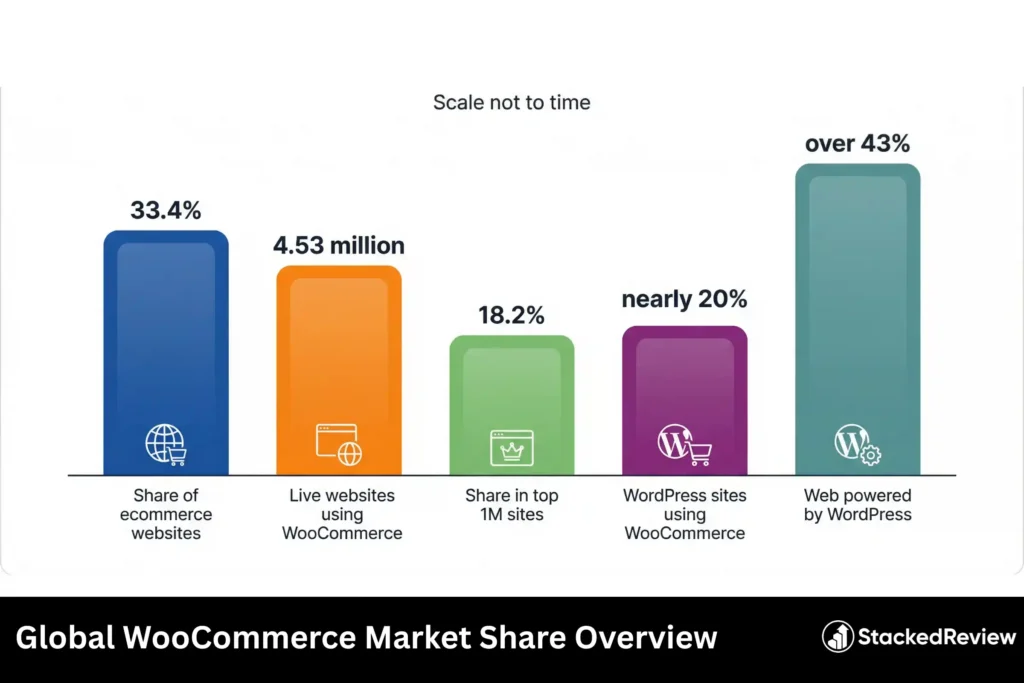
WooCommerce remains the most widely used ecommerce technology by sheer volume of active websites, significantly outpacing many SaaS competitors in raw store counts.
Despite the rise of no-code platforms, WooCommerce retains a massive user base due to its open-source nature and extensive plugin ecosystem.
WooCommerce Hotspots: Leading Nations for Store Growth
Adoption rates vary significantly by region, with English-speaking markets leading the charge in 2026.
| Rank | Country | Estimated Store Count | Market Share % |
|---|---|---|---|
| 1 | United States | 1,200,000+ | ~10.1% |
| 2 | United Kingdom | 175,000+ | ~3.7% |
| 3 | India | 140,000+ | ~3.2% |
| 4 | Germany | 110,000+ | ~2.5% |
| 5 | Brazil | 95,000+ | ~2.1% |
Regional data helps developers target their WooCommerce theme development and plugin marketing efforts effectively.
WooCommerce Financial & Revenue Stats
For many merchants, WooCommerce is not just a side hustle but a primary revenue engine generating significant annual turnover. Mature WooCommerce stores are highly profitable entities comparable to their SaaS counterparts.
With proper optimisation, WooCommerce stores can scale to handle millions in revenue without the escalating costs associated with tiered SaaS plans.
Active WooCommerce Stores: 2026 Installation Trends Data
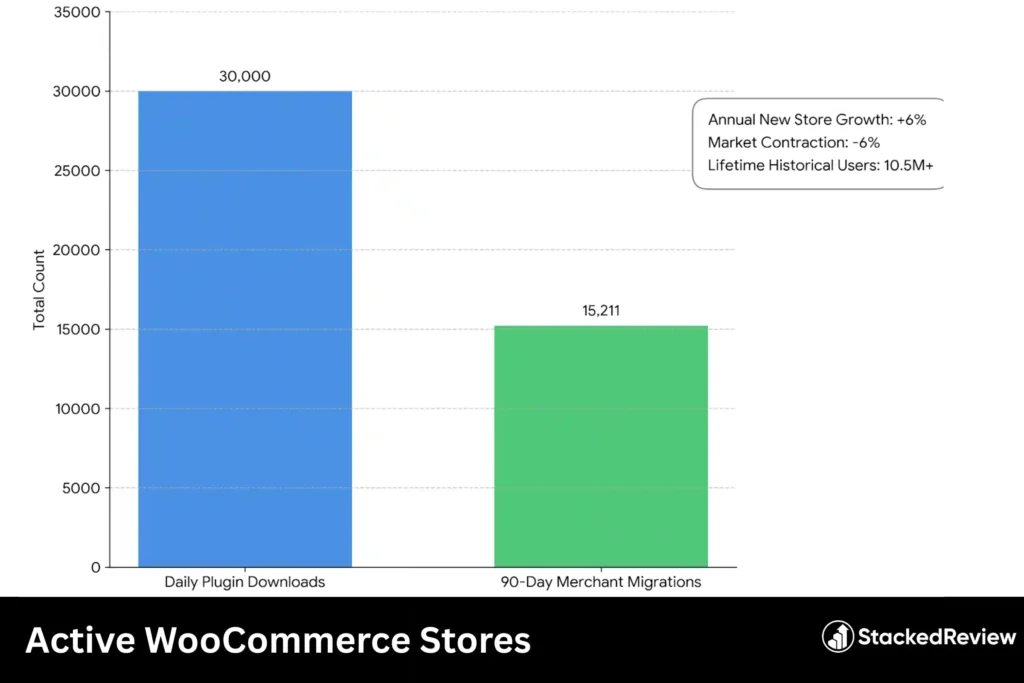
While growth has stabilised compared to the pandemic boom, WooCommerce statistics for 2026 show steady adoption.
The platform sees thousands of new installs daily, driven by the creator economy and small businesses.
Implication: The high churn rate suggests many users test WooCommerce for low-cost setups; retention depends on successful WooCommerce hosting and maintenance.
Which Payment Gateways WooCommerce Merchants Prefer Most
Payment processing remains a critical component of the WooCommerce ecosystem, with a strong shift towards flexible, multi-currency solutions.
In 2026, the market for payment gateways is projected to reach $20.96 billion, driving innovation in how stores accept money.
| Payment Gateway | Usage Share | Key Feature |
|---|---|---|
| Stripe | 48% | Developer-friendly, deep integration |
| PayPal | 40% | High consumer trust, widespread use |
| Square | 8% | Strong POS integration for physical stores |
| WooPayments | 15% | Native integration, growing rapidly |
| Authorise.net | 3% | Legacy enterprise preference |
Merchants are increasingly adopting self-hosted gateways and native solutions like WooPayments to retain tighter control over transaction data and fees.
Best-Selling WooCommerce Themes Dominating Store Design
The visual layer of WooCommerce is powered by a vast library of themes, with performance-focused designs gaining the most traction.
Implication: Astra and Hello Elementor are safe bets for long-term support. Avoid heavy, unoptimised themes to pass CWV checks.
Mobile Shopping: 62% of WooCommerce Orders Start Here
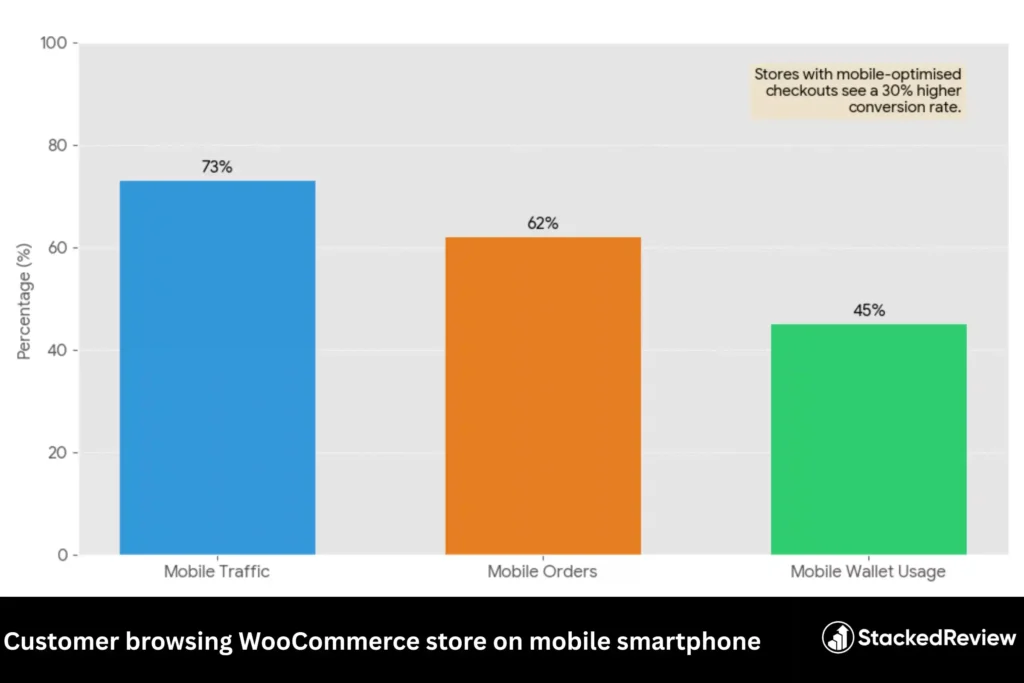
Mobile shopping is no longer optional; it is the primary revenue driver for WooCommerce online shops.
Optimising for mobile is the single most effective way to improve your WooCommerce SEO rankings and user experience.
Fastest WooCommerce Hosting: Speed Benchmarks That Matter
The performance of a WooCommerce store is directly tied to the quality of its hosting, with speed being a major ranking factor.
Investments in premium hosting are proving to be cost-effective by significantly reducing bounce rates and cart abandonment.
Cart Abandonment Crisis: What WooCommerce Data Reveals
Cart abandonment remains the plague of ecommerce, but WooCommerce merchants are using smarter tools to recover lost sales.
- The average cart abandonment rate for WooCommerce stores sits at roughly 70%.
- Mobile abandonment rates are higher, often exceeding 80% due to friction.
- The average conversion rate across all WooCommerce stores is approximately 2.3%.
- Top-performing stores achieve conversion rates upwards of 5.5%.
- Abandoned cart recovery emails can recover 10-15% of lost revenue.
Merchants who implement one-page checkouts and guest checkout options consistently report lower abandonment figures.
How Top WooCommerce Stores Win at Organic Search
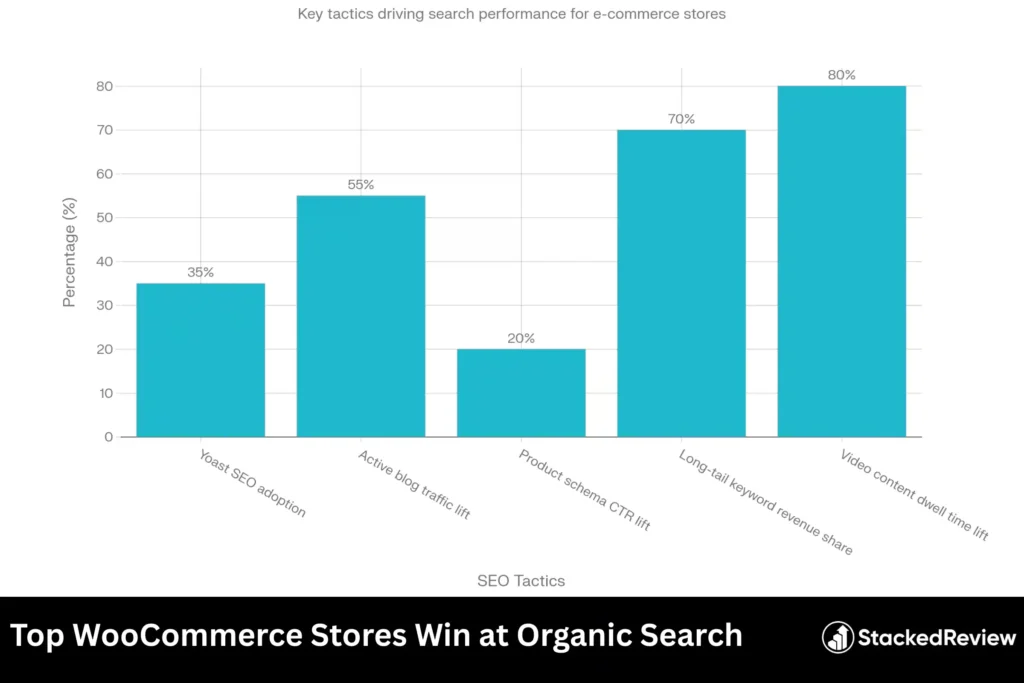
Search Engine Optimisation is the lifeblood of organic traffic, and WooCommerce’s structure offers distinct advantages.
Leveraging the native blogging capabilities of WordPress gives WooCommerce merchants a significant advantage in content marketing and SEO.
Must-Have WooCommerce Plugins: Usage Stats and Trends
The extensibility of WooCommerce is its greatest asset, with thousands of plugins available to add virtually any feature.
| Plugin Category | Top Plugin | Usage Rate | Primary Benefit |
|---|---|---|---|
| SEO | Yoast SEO | 38% | On-page SEO optimisation |
| Speed | WP Rocket | 22% | Caching and Core Web Vitals |
| Page Builder | Elementor | 45% | Visual design control |
| Analytics | Google Site Kit | 32% | Google Search Console data |
| Security | Wordfence | 28% | Firewall and malware scan |
Careful selection of lightweight WooCommerce plugins prevents code bloat and maintains site performance.
Protecting Your WooCommerce Store: 2026 Security Data
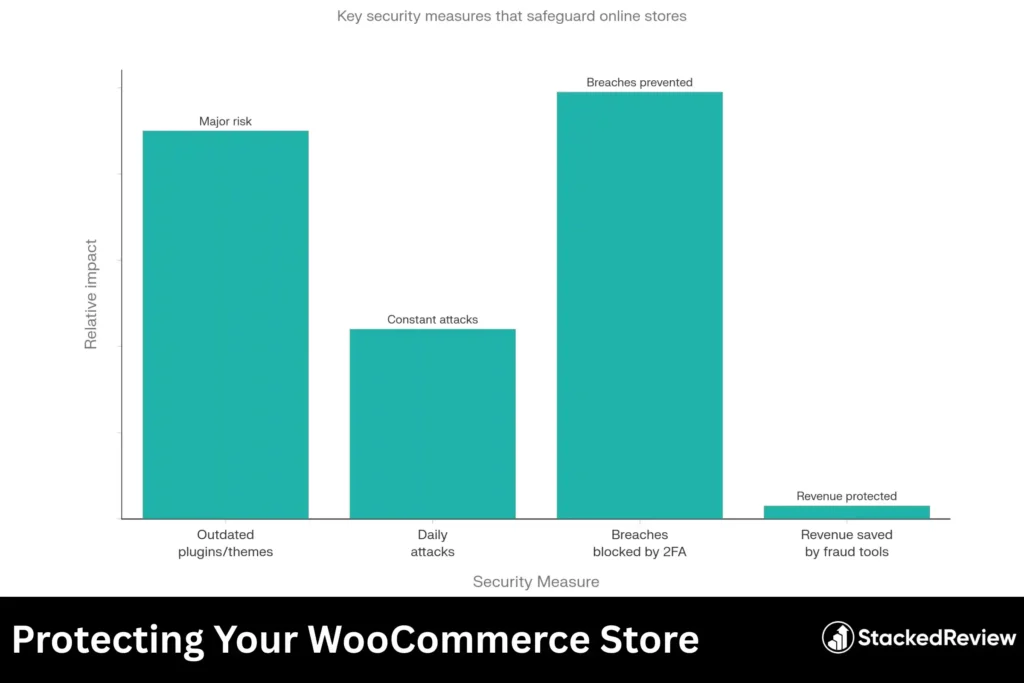
As transaction volumes increase, so do the threats facing online merchants, making security a top priority. WooCommerce stores are increasingly targeted by bots, but awareness and defensive tools are also on the rise.
Proactive security measures, such as regular updates and managed firewalls, are non-negotiable for protecting customer data and store integrity.
What WooCommerce Stores Sell: Product Category Breakdown
The types of products sold on WooCommerce are shifting, with digital goods and subscriptions seeing rapid growth.
This shift towards digital and recurring revenue models highlights the platform’s adaptability beyond traditional retail.
Customer Retention & Loyalty
Acquiring a new customer is expensive, which is why retention strategies are central to successful WooCommerce stores.
Building a loyal community around a brand is proving to be the most sustainable path to growth for WooCommerce merchants.
WooCommerce Shipping Stats: Carriers Merchants Trust Most
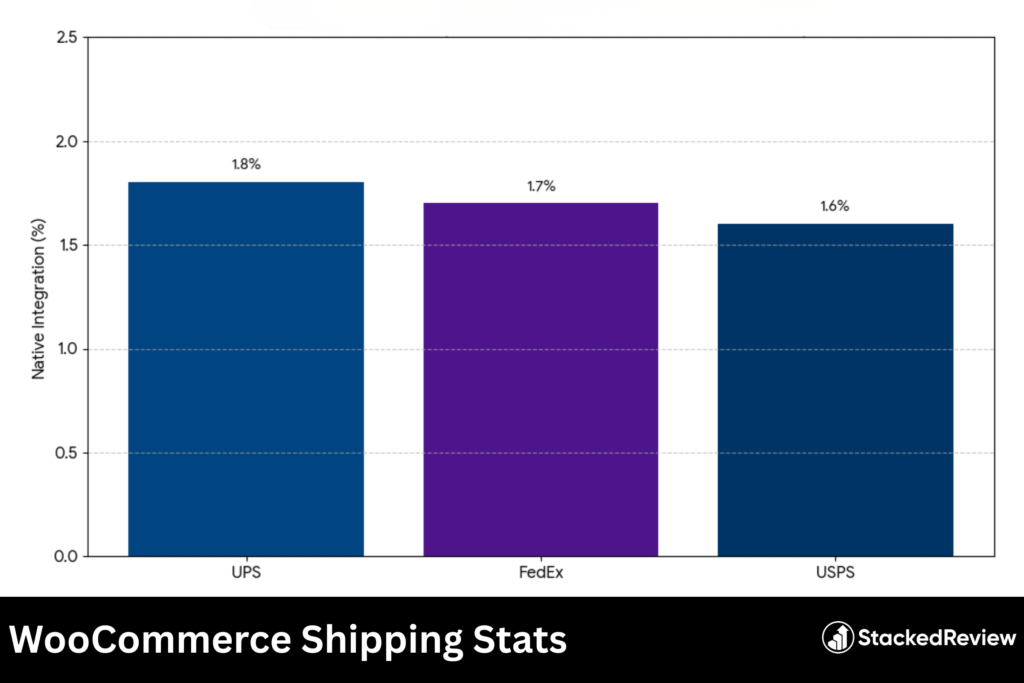
Shipping strategy defines profitability. WooCommerce shipping stats indicate a strong consumer preference for free and fast delivery options.
Free shipping is the top purchase driver. Use “Free Shipping Over $X” plugins to protect margins while meeting consumer demand.
Dropshipping Profits: WooCommerce Margin Stats for 2026
Dropshipping remains a popular entry point for entrepreneurs, with WooCommerce serving as a primary platform for this business model.
- WooCommerce powers approximately 20% of all dropshipping websites.
- AliExpress dropshipping plugins are active on thousands of stores.
- The global dropshipping market is valued at over $300 billion.
- Average profit margins for dropshipping stores range from 15% to 20%.
- Print-on-demand is the fastest-growing segment within dropshipping.
While competitive, dropshipping on WooCommerce offers a low-risk path to testing product ideas and building a brand.
B2B WooCommerce Sales Growing Twice as Fast
WooCommerce is not just for B2C; its B2B capabilities are expanding rapidly to meet the needs of wholesalers.
The flexibility to handle complex pricing structures makes WooCommerce an ideal solution for the digitisation of traditional B2B sales channels.
WooCommerce Community & Support
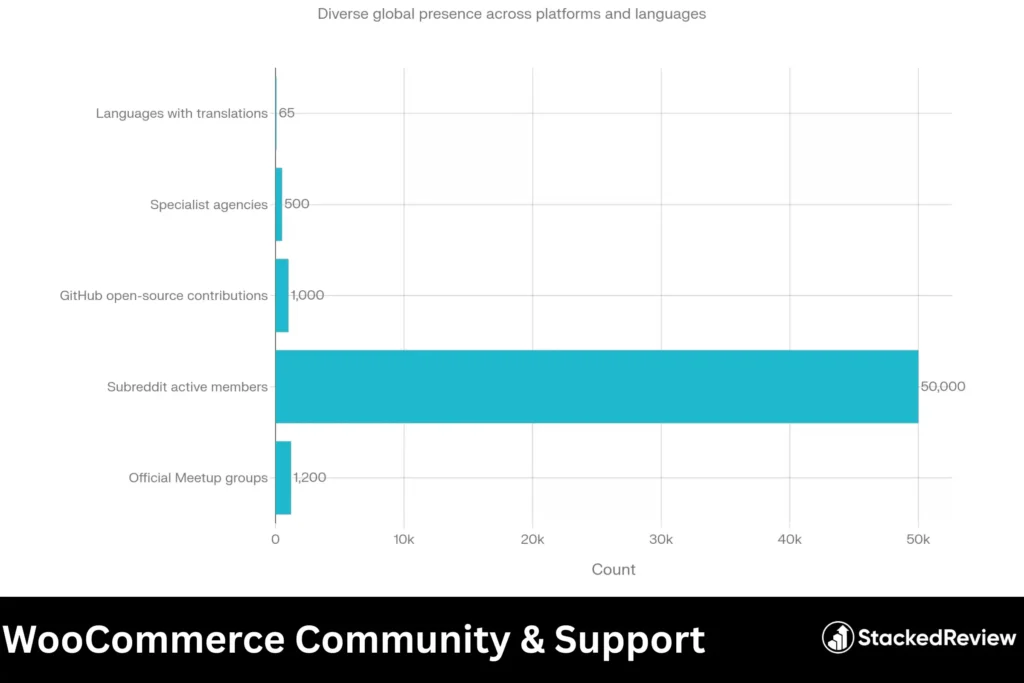
The strength of WooCommerce lies in its massive, active community of developers and shop owners. This network provides a level of support and resource availability that proprietary platforms cannot match.
This vibrant ecosystem ensures that help is always available, whether through official channels, forums, or third-party experts.
Migration Trends: Who Joins and Leaves WooCommerce
The flow of merchants between platforms shows where WooCommerce vs Shopify battles are won. While some move to SaaS for simplicity, others flock to WooCommerce for control.
- 19,402 stores migrated away from WooCommerce in a recent 90-day period.
- 15,211 stores migrated to WooCommerce in the same window.
- Shopify is the destination for 40% of departing WooCommerce merchants.
- OpenCart and Magento users frequently migrate to WooCommerce for better ease of use.
- High fees on SaaS platforms are the #1 driver for migrating to WooCommerce.
The platform maintains a healthy equilibrium, attracting cost-conscious merchants while losing those seeking hands-off management.
Best-Performing Niches for WooCommerce in 2026
Certain industries favour WooCommerce due to its flexibility and lower cost of entry. In 2026, retail and hobbyist sectors continue to dominate the platform’s user base.
Implication: Niche SEO strategies in “Home & Garden” must account for high WooCommerce saturation; expect strong competition in these SERPs.
Marketing Automation Makes WooCommerce Stores Grow 2x Faster
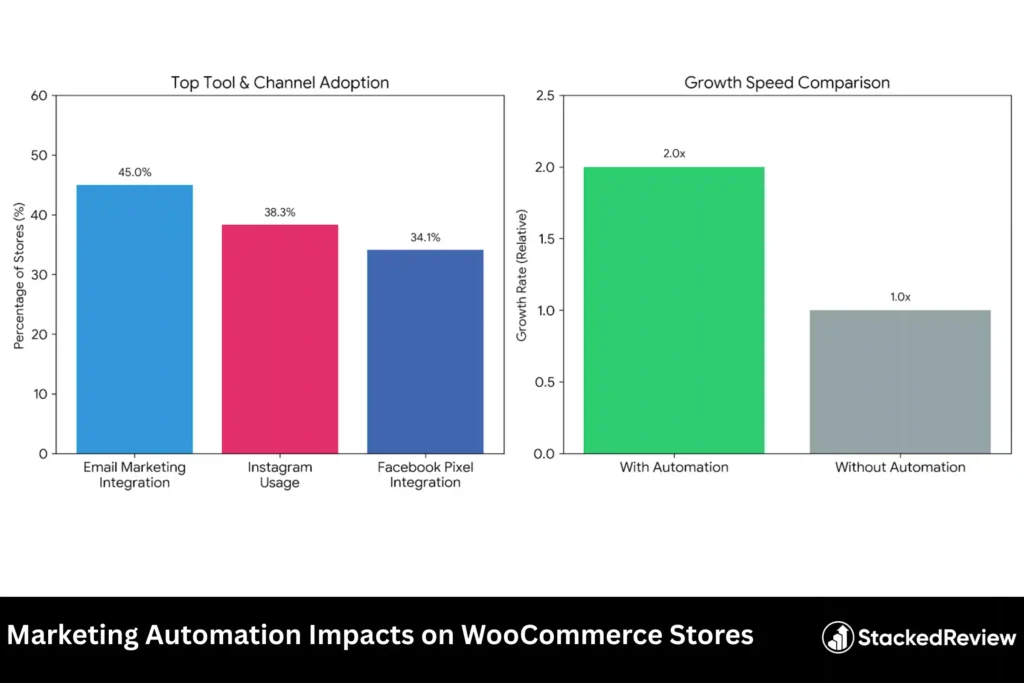
Marketing automation is the engine of growth. WooCommerce marketing stats show a shift towards integrated email and CRM solutions.
- 45% of WooCommerce stores use an email marketing integration.
- Stores using marketing automation grow 2x faster than those that do not.
- Instagram is the top social channel, used by 38.3% of stores.
- Facebook pixel integration is present on 34.1% of sites.
- Google Shopping feed plugins are essential for 2026 retail visibility.
Implication: Email marketing is not dead; it is the most profitable channel. Integrate tools like MailChimp or Klaviyo deeply with your checkout data.
Store Retention Challenges Facing WooCommerce in 2026
Growth patterns in 2026 show a maturing market where new store creation balances with consolidation. The WooCommerce ecosystem sees thousands of new entrants daily.
Retention remains a challenge as SaaS tools market aggressively to WordPress store owners. However, the influx of new users keeps the total user base stable and massive.
WooCommerce vs Shopify: 2026 Market Share Comparison
The rivalry between WooCommerce vs Shopify intensifies in 2026, with WooCommerce leading in total store volume while Shopify dominates in enterprise-level Gross Merchandise Volume (GMV).
| Metric | WooCommerce | Shopify |
|---|---|---|
| Global Store Count | 4.53 Million | 2.66 Million |
| Market Share (All Sites) | 33.4% | 19.6% |
| Top 1 Million Sites Share | 18.2% | 28.8% |
| Transaction Fees | 0% (Core) | 0.5% – 2% (Unless using Shopify Payments) |
| Primary User Base | SMBs, Agencies, Developers | D2C Brands, Enterprise |
While Shopify captures more high-revenue enterprise clients, WooCommerce remains the preferred choice for millions of independent merchants globally.
Conclusion
WooCommerce now stands as a proven ecommerce platform, driving billions in yearly online sales and supporting millions of active stores worldwide.
From mobile commerce growth and rising AI automation to higher customer retention rates, each statistic highlights where serious brands gain an edge.
Use these WooCommerce insights to refine SEO strategy, speed up checkout, and strengthen conversion rates across every funnel stage.
So after seeing these WooCommerce numbers in 2026, which metric will you act on first?

Affiliate Disclosure: This post may contain some affiliate links, which means we may receive a commission if you purchase something that we recommend at no additional cost for you (none whatsoever!)
Similar Posts






Verification process
Editorial standards
We’re a team of real users — not bots, not press-release copiers. Here’s exactly how we earn your trust on every single post.
We Actually Buy the Products
Every deal on this site is tested with a real purchase using our own accounts. We don’t rely on screenshots sent by vendors or press kits. If we say the discount works, we’ve clicked through checkout ourselves.
No Pay-to-Rank Policy
We never accept payment to feature or rank a deal higher. Affiliate commissions don’t influence our editorial scores — a bad deal stays ranked low regardless of commission size.
Monthly Re-Verification
Pricing changes fast. Our team re-tests every published deal at least once a month and immediately updates or removes any that have expired, changed, or been capped.
Expert Editorial Team
Our writers and editors have collectively spent 40,000+ hours hands-on with digital tools. We know what a fair price looks like — and we call out bad deals even when they’d earn us commissions.
Transparent Scoring Criteria
Every score is calculated from a public rubric: discount value, feature-to-price ratio, redemption ease, plan flexibility, and competitor comparison. No hidden weighting, ever.
Reader Feedback Loop
Thousands of readers report broken deals each month. Our team investigates every report within 24 hours and updates the page the same day a deal stops working.
Jaclyn Donaldson
Jaclyn is a content strategist at StackedReview with a passion for empowering small businesses. She specializes in dissecting social media advertising costs and hunting down the best-value deals. Her goal is to help brands stretch their budget further without compromising on results.