
CRM Statistics 2026: Market Size, ROI and Adoption

By :
Jaclyn Donaldson
May 14, 2026
CRM software is now a $109 billion global industry in 2026. And it is still growing fast. Nearly 91% of companies with 10 or more employees rely on CRM software to manage sales, marketing and customer relationships.
For SaaS marketers, understanding CRM data is not optional. It is essential for planning budgets, picking platforms and proving ROI.
At StackedReview, we have tracked CRM tools for years. Below are the most up-to-date CRM statistics for 2026 backed by trusted sources.
CRM Market Size and Growth in 2026
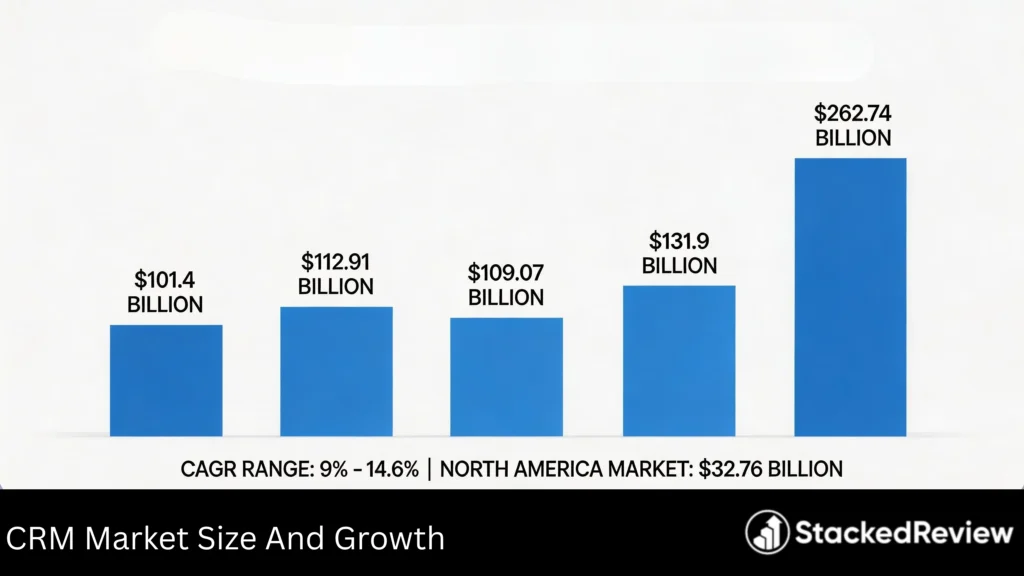
The global CRM market is booming. Revenue for CRM software worldwide is forecast to reach $109.07 billion in 2026. That is up from roughly $101.4 billion in 2024.
| Year | Global CRM Market Size (USD) |
|---|---|
| 2024 | $101.4 billion |
| 2025 | $112.91 billion |
| 2026 | $109.07 billion |
| 2028 | $131.9 billion |
| 2032 | $262.74 billion |
The market is growing at a CAGR of between 9% and 14.6% depending on region and deployment model. North America remains dominant with a current market size of around $32.76 billion.
At StackedReview, we have seen firsthand how brands are moving budgets away from standalone tools into all-in-one CRM platforms. That shift alone is fuelling much of this growth.
CRM Adoption Rates Across Business Sizes
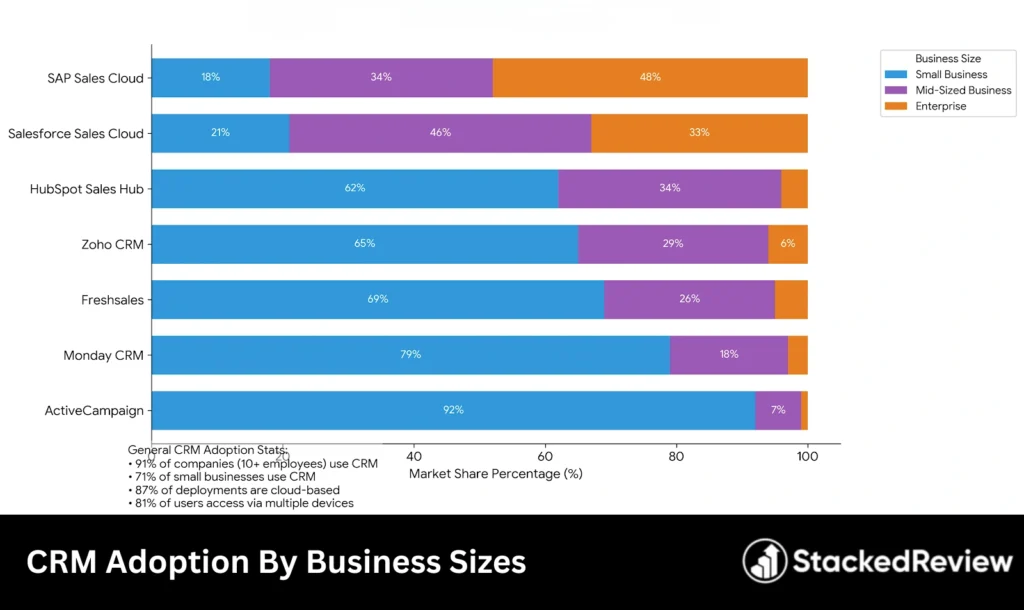
CRM is no longer reserved for big enterprises. Adoption is widespread.
| CRM Platform | Small Business | Mid-Sized Business | Enterprise |
|---|---|---|---|
| Salesforce Sales Cloud | 21% | 46% | 33% |
| HubSpot Sales Hub | 62% | 34% | 4% |
| ActiveCampaign | 92% | 7% | 1% |
| SAP Sales Cloud | 18% | 34% | 48% |
| Zoho CRM | 65% | 29% | 6% |
| Monday CRM | 79% | 18% | 3% |
| Freshsales | 69% | 26% | 5% |
HubSpot and ActiveCampaign dominate the small business segment. Salesforce and SAP control the enterprise space. From our experience reviewing CRM tools at StackedReview, HubSpot remains the easiest entry point for SaaS startups. Salesforce is better suited for teams that have outgrown simpler tools.
CRM ROI Statistics That SaaS Marketers Should Know
ROI is what convinces CFOs. And CRM numbers deliver.
Some analysts note that average ROI may be normalising closer to $3.10 per dollar as markets mature and more businesses adopt basic CRM. But even at that lower figure, CRM remains one of the highest-returning software investments a SaaS company can make.
At StackedReview, our team has consistently found that companies implementing CRM properly see meaningful revenue gains within 6 to 12 months. Poor ROI almost always traces back to bad setup, not the tool itself.
Customer Retention and Experience Statistics
CRM is not just about closing deals. It is about keeping customers.
Customers now interact with brands across an average of 7 different channels. Without a centralised CRM, delivering consistent experiences across those touchpoints becomes nearly impossible.
A 5% boost in retention can increase profits by 25% to 95%. That is why CRM investment pays off especially well when combined with customer retention strategies.
AI in CRM Statistics for 2026
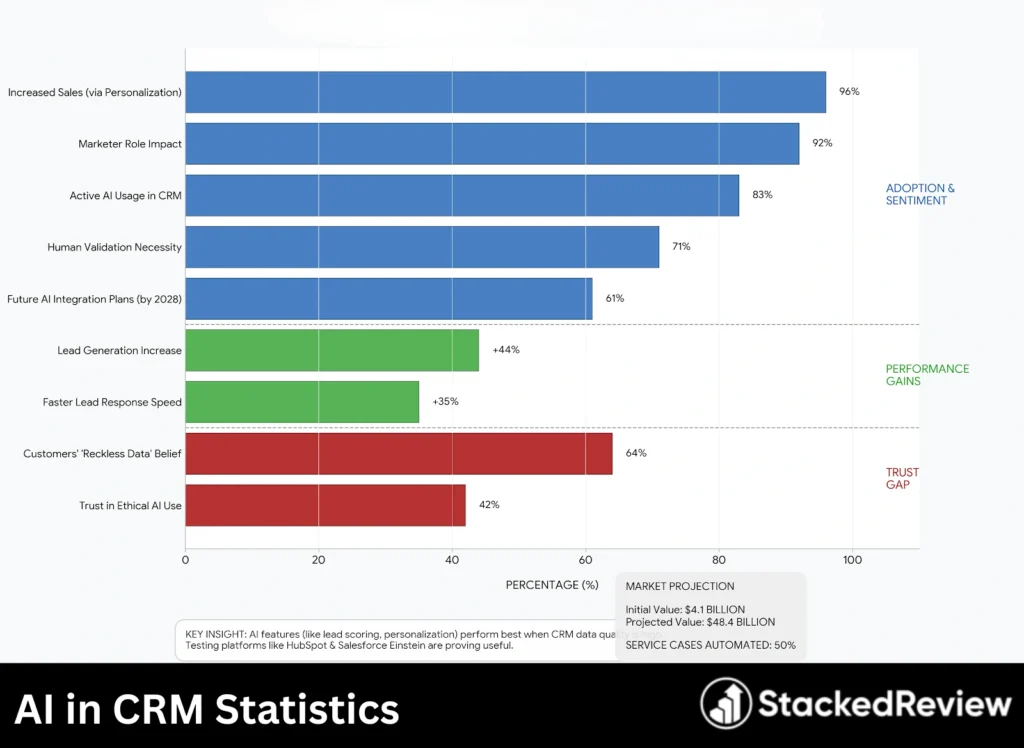
AI is reshaping CRM fast. This is not a future prediction. It is happening now.
Trust remains an issue. 64% of customers believe companies are reckless with data. Only 42% trust businesses to use AI ethically. And 71% believe human validation of AI outputs is necessary.
From our testing at StackedReview, AI features in HubSpot and Salesforce Einstein are genuinely useful for lead scoring and email personalisation. But they work best when CRM data quality is high.
CRM Data Quality and Integration Challenges
AI and automation only work well with clean data. Most businesses struggle here.
This is a critical gap. CRM underperformance is rarely about the software. It is almost always a data governance and integration problem.
If you are a SaaS marketer evaluating CRM tools, we recommend starting with data hygiene before adding advanced features.
Mobile CRM Statistics
Mobile CRM is growing in line with remote and hybrid work trends.
For SaaS sales teams operating across time zones and working remotely, mobile CRM access is no longer a luxury. It is a daily necessity.
CRM Usage by Industry in 2026
CRM is not limited to one sector. It spans every major industry.
SaaS companies are the heaviest CRM users. An average mid-size company deploys 185 SaaS applications. CRM is almost always among the first three tools adopted.
Large enterprises manage an average of 371 SaaS applications. That sprawl makes CRM integration and data centralisation even more critical.
Cloud CRM Adoption Stats
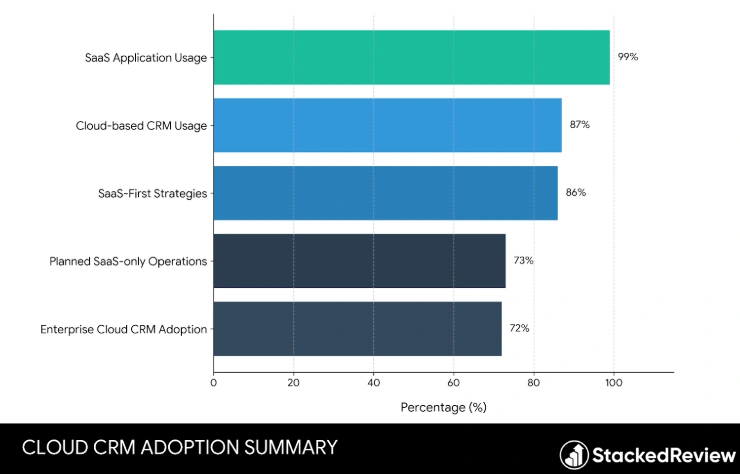
Cloud-based CRM has become the default. On-premise solutions are fading.
87% of businesses now use cloud-based CRM software. Only about 10% of companies maintain primarily on-premise solutions.
Cloud CRM growth is driven by remote work, flexibility, and lower upfront costs. Businesses want CRM tools they can access from anywhere without heavy infrastructure investment.
Over 72% of enterprises are adopting cloud-based CRM solutions to enhance customer engagement and streamline sales operations.
Key cloud CRM statistics for 2026:
North America leads cloud CRM adoption with a 52% share of the SaaS market, followed by Europe at 25% and Asia-Pacific at 17%.
The shift to cloud is not just a trend. It is a permanent structural change in how businesses buy and use software. SaaS-first is now the standard operating model.
Human and AI Collaboration Inside CRM
AI is not replacing humans in CRM workflows. It is freeing them up.
AI handles repetitive tasks like data entry, ticket routing and lead scoring. Humans handle the conversations, negotiations and relationship-building that close deals and retain accounts.
CRM Spending by Region
North America leads, but other regions are catching up.
CRM Challenges and Barriers in 2026
CRM is powerful. But it comes with real challenges.
32% of CRM users say a lack of technical skills is their biggest problem. Cost concerns affect 31%, and data migration headaches trouble 30%.
Here is what holds businesses back from CRM success:
| Challenge | Percentage of Businesses Affected |
|---|---|
| Lack of tech skills | 32% |
| Cost concerns | 31% |
| Data migration issues | 30% |
| Integration with existing tools | 28% |
| User adoption resistance | 25% |
Many CRM implementations fail not because of the software. They fail because of poor onboarding, weak training, and resistance from teams who are used to spreadsheets.
At StackedReview, we always recommend starting simple. Choose a CRM that matches your team’s skill level. Free and low-cost platforms like HubSpot CRM or Zoho CRM work well for teams getting started. Scale up once your team is comfortable.

What These CRM Statistics Mean for SaaS Marketers
At StackedReview, we review SaaS tools daily. CRM platforms sit at the centre of every marketing and sales stack we evaluate.
Here is what the 2026 data tells us:
For SaaS marketers budgeting for 2026 and beyond, CRM investment is not just about managing contacts. It is about building an infrastructure that supports personalised marketing, faster sales cycles and better customer lifetime value.
Affiliate Disclosure: This post may contain some affiliate links, which means we may receive a commission if you purchase something that we recommend at no additional cost for you (none whatsoever!)
Similar Posts




Verification process
Editorial standards
We’re a team of real users — not bots, not press-release copiers. Here’s exactly how we earn your trust on every single post.
We Actually Buy the Products
Every deal on this site is tested with a real purchase using our own accounts. We don’t rely on screenshots sent by vendors or press kits. If we say the discount works, we’ve clicked through checkout ourselves.
No Pay-to-Rank Policy
We never accept payment to feature or rank a deal higher. Affiliate commissions don’t influence our editorial scores — a bad deal stays ranked low regardless of commission size.
Monthly Re-Verification
Pricing changes fast. Our team re-tests every published deal at least once a month and immediately updates or removes any that have expired, changed, or been capped.
Expert Editorial Team
Our writers and editors have collectively spent 40,000+ hours hands-on with digital tools. We know what a fair price looks like — and we call out bad deals even when they’d earn us commissions.
Transparent Scoring Criteria
Every score is calculated from a public rubric: discount value, feature-to-price ratio, redemption ease, plan flexibility, and competitor comparison. No hidden weighting, ever.
Reader Feedback Loop
Thousands of readers report broken deals each month. Our team investigates every report within 24 hours and updates the page the same day a deal stops working.
Jaclyn Donaldson
Jaclyn is a content strategist at StackedReview with a passion for empowering small businesses. She specializes in dissecting social media advertising costs and hunting down the best-value deals. Her goal is to help brands stretch their budget further without compromising on results.