
HubSpot Statistics and Trends for 2026 (Updated Numbers)

By :
Jaclyn Donaldson
April 13, 2026

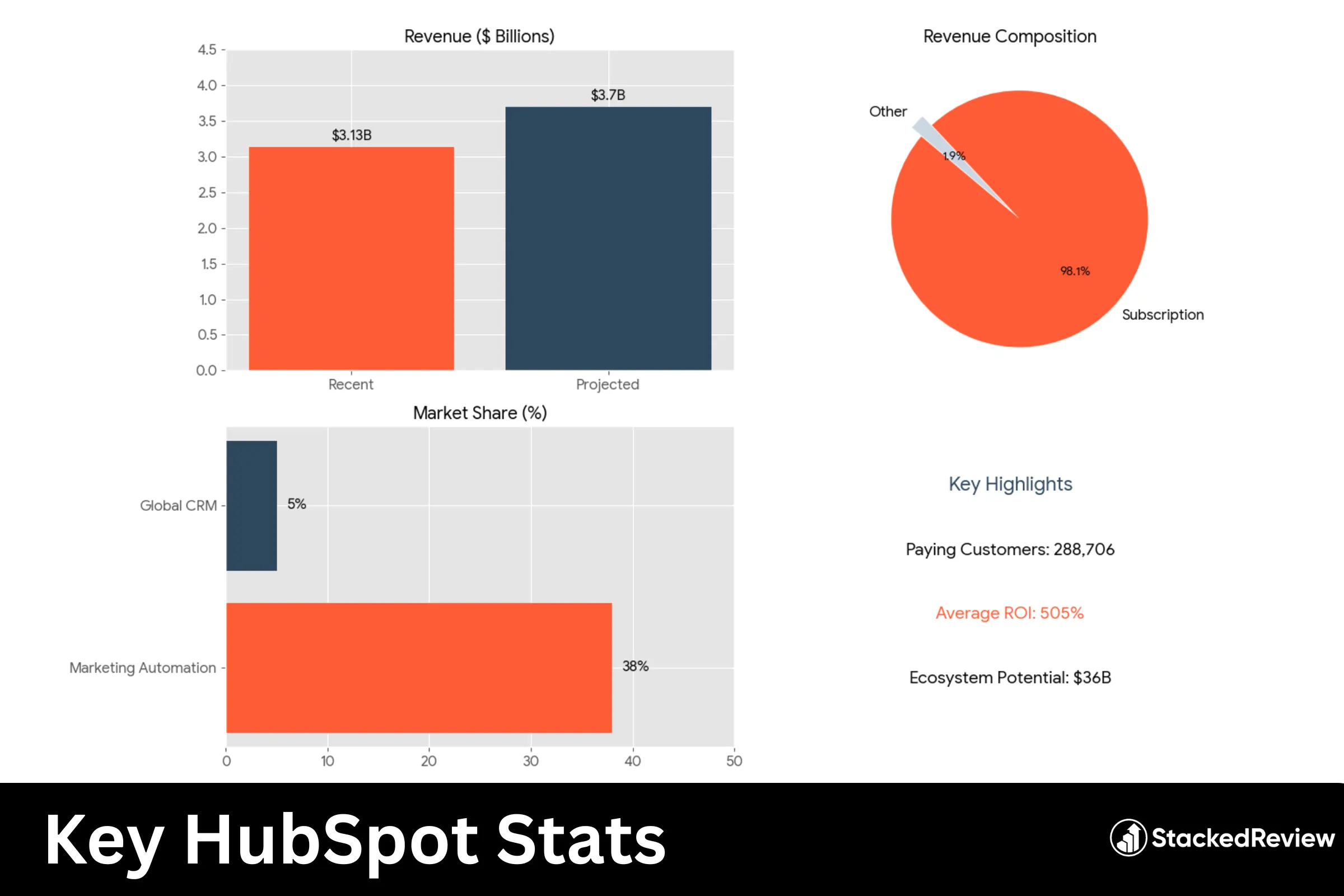
HubSpot is on track to generate $3.7 billion in revenue in 2026, up from $3.13 billion in 2025. With nearly 290,000 paying customers, 8,800+ employees and a firm grip on the marketing automation software market, HubSpot keeps growing faster than most enterprise SaaS companies twice its size.
For marketers, sales leaders and business owners, these numbers paint a clear picture of where the platform stands today and where it is headed. Here are all the updated HubSpot statistics for 2026 you need to know.
Key HubSpot Stats at a Glance
💰 HubSpot Revenue Statistics for 2026
HubSpot has officially guided revenue of $3.69 to $3.70 billion for fiscal year 2026. That represents roughly 18% growth over 2025’s reported $3.13 billion.finance.
In 2025, total revenue came in at $3.13 billion. Revenue grew 19% on an as-reported basis and 18.2% in constant currency. Fourth-quarter revenue alone was $846.75 million, topping analyst estimates of $830.54 million.
Here is how HubSpot annual revenue has grown year by year:
| Year | Total Revenue | Year-over-Year Growth |
|---|---|---|
| 2016 | $270.97 million | — |
| 2018 | $512.98 million | — |
| 2019 | $674.86 million | 31.5% |
| 2020 | $883.03 million | 30.8% |
| 2021 | $1.30 billion | 47.2% |
| 2022 | $1.73 billion | 33.1% |
| 2023 | $2.17 billion | 25.5% |
| 2024 | $2.63 billion | 21.1% |
| 2025 | $3.13 billion | 19.0% |
| 2026 (Projected) | $3.69 to $3.70 billion | ~18% |
A few revenue highlights worth noting:
HubSpot’s revenue growth rate of 18% to 20% consistently outpaces Salesforce, which grows at 8% to 11% annually. For a company past $3 billion in annual revenue, maintaining this pace puts HubSpot among the top-performing SaaS businesses globally.
📋 HubSpot Subscription Revenue Breakdown
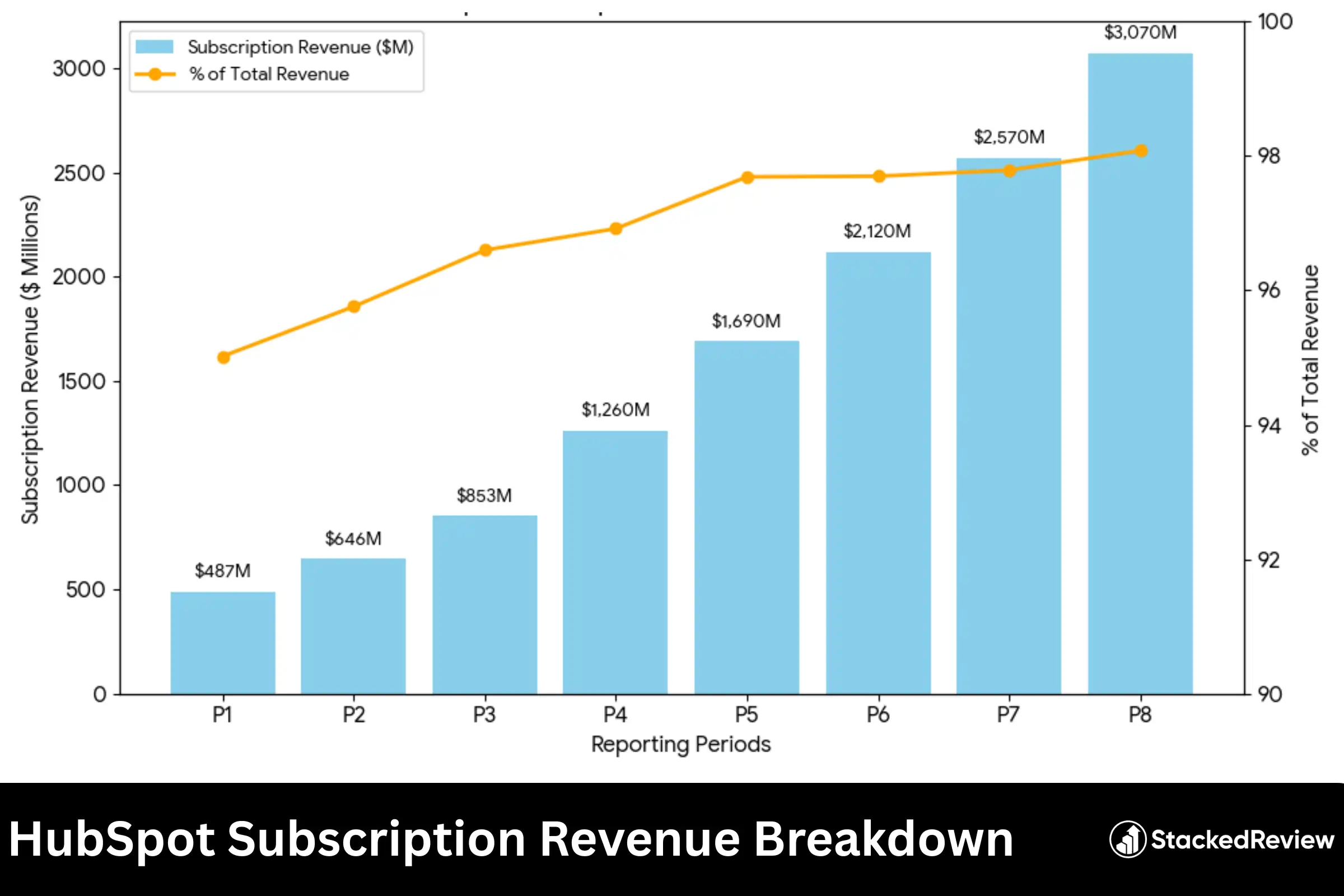
Subscriptions are the engine behind HubSpot’s growth. In 2025, subscription revenue reached $3.07 billion. That is 98.08% of total revenue.
Subscription revenue has grown by 274% since 2020, when it was $853 million.
| Year | Subscription Revenue | % of Total Revenue |
|---|---|---|
| 2018 | $487.45 million | 95.02% |
| 2019 | $646.27 million | 95.76% |
| 2020 | $853.02 million | 96.60% |
| 2021 | $1.26 billion | 96.92% |
| 2022 | $1.69 billion | 97.69% |
| 2023 | $2.12 billion | 97.70% |
| 2024 | $2.57 billion | 97.79% |
| 2025 | $3.07 billion | 98.08% |
Professional services and other revenue made up just $60 million (1.92%) in 2025. Services revenue grew only 3.45% year over year. HubSpot relies on its partner ecosystem for implementation, keeping services lean.
Subscription share has climbed from 88.63% in 2010 to 98.08% in 2025. HubSpot runs one of the purest SaaS subscription revenue models in enterprise software today. For 2026, subscription revenue is expected to make up over 98% of projected $3.7 billion in total revenue.
👥 HubSpot Customer Growth Statistics in 2026
HubSpot ended 2025 with 288,706 paying customers. That is a 16% jump from 247,939 at end of 2024. Over 40,000 net new customers signed up during 2025. In fourth quarter alone, HubSpot added 9,800 new paying accounts.
| Year | Paying Customers | Year-over-Year Growth |
|---|---|---|
| 2014 | 13,607 | — |
| 2016 | 28,097 | 55% |
| 2018 | 56,628 | 36% |
| 2019 | 73,483 | 30% |
| 2020 | 103,994 | 42% |
| 2021 | 135,442 | 30% |
| 2022 | 167,386 | 24% |
| 2023 | 205,091 | 23% |
| 2024 | 247,939 | 21% |
| 2025 | 288,706 | 16% |
HubSpot now operates in 135+ countries worldwide. High-profile brands like OpenAI, Eventbrite and DoorDash all use HubSpot for marketing and sales operations.
Customer growth slowed slightly from 21% in 2024 to 16% in 2025. But adding 40,000+ net new customers in one year remains impressive. At current rates, HubSpot could surpass 330,000 paying customers by the end of 2026.
These numbers do not include millions of users on HubSpot’s free CRM tools. Total platform users including free accounts are significantly higher.
💵 Average Revenue Per HubSpot Customer in 2026
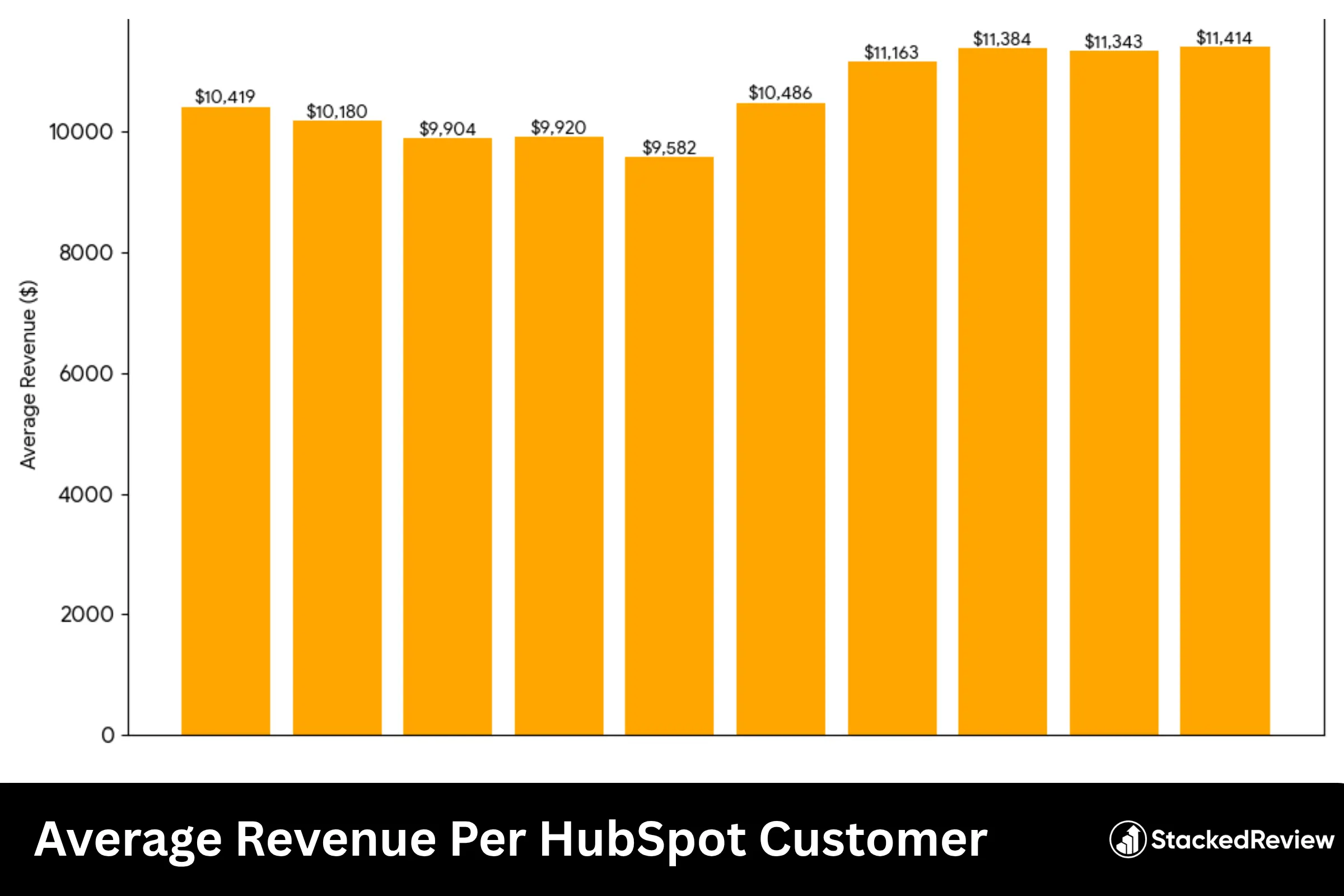
HubSpot generated $11,414 in average subscription revenue per customer in 2025. During fourth quarter, average subscription revenue per customer reached $11,683, up 3% from same period in 2024.
| Year | Average Subscription Revenue Per Customer |
|---|---|
| 2015 | $10,419 |
| 2017 | $10,180 |
| 2018 | $9,904 |
| 2019 | $9,920 |
| 2020 | $9,582 |
| 2021 | $10,486 |
| 2022 | $11,163 |
| 2023 | $11,384 |
| 2024 | $11,343 |
| 2025 | $11,414 |
Average revenue dipped between 2016 and 2020. That happened because HubSpot introduced free CRM tools and lower-priced starter plans to attract smaller businesses. Since 2021, per-customer revenue has stayed above $10,000 as customers upgrade to premium tiers.
Net revenue retention rates stay above 100%. Existing customers are spending more each year, not less. Upselling across Marketing Hub, Sales Hub, Service Hub and Commerce Hub drives this increase.
For 2026, average revenue per customer is expected to climb further as enterprise adoption grows and AI tools push customers toward higher-tier plans.
🌍 HubSpot Revenue by Region
HubSpot generates income from three key regions. America leads, but Europe and Asia Pacific are gaining ground fast.
| Region | 2024 Revenue | % of Total | Growth from 2023 |
|---|---|---|---|
| Americas | $1.59 billion | 60.47% | 20.25% |
| Europe | $825.6 million | 31.42% | 23.56% |
| Asia Pacific | $213.06 million | 8.11% | 18.10% |
Key regional takeaways:
HubSpot’s platform supports multiple languages and currencies, making it suitable for businesses operating across borders. In 2026, international revenue is expected to grow faster than domestic revenue as emerging markets adopt CRM solutions at higher rates.
📈 HubSpot CRM Market Share in 2026
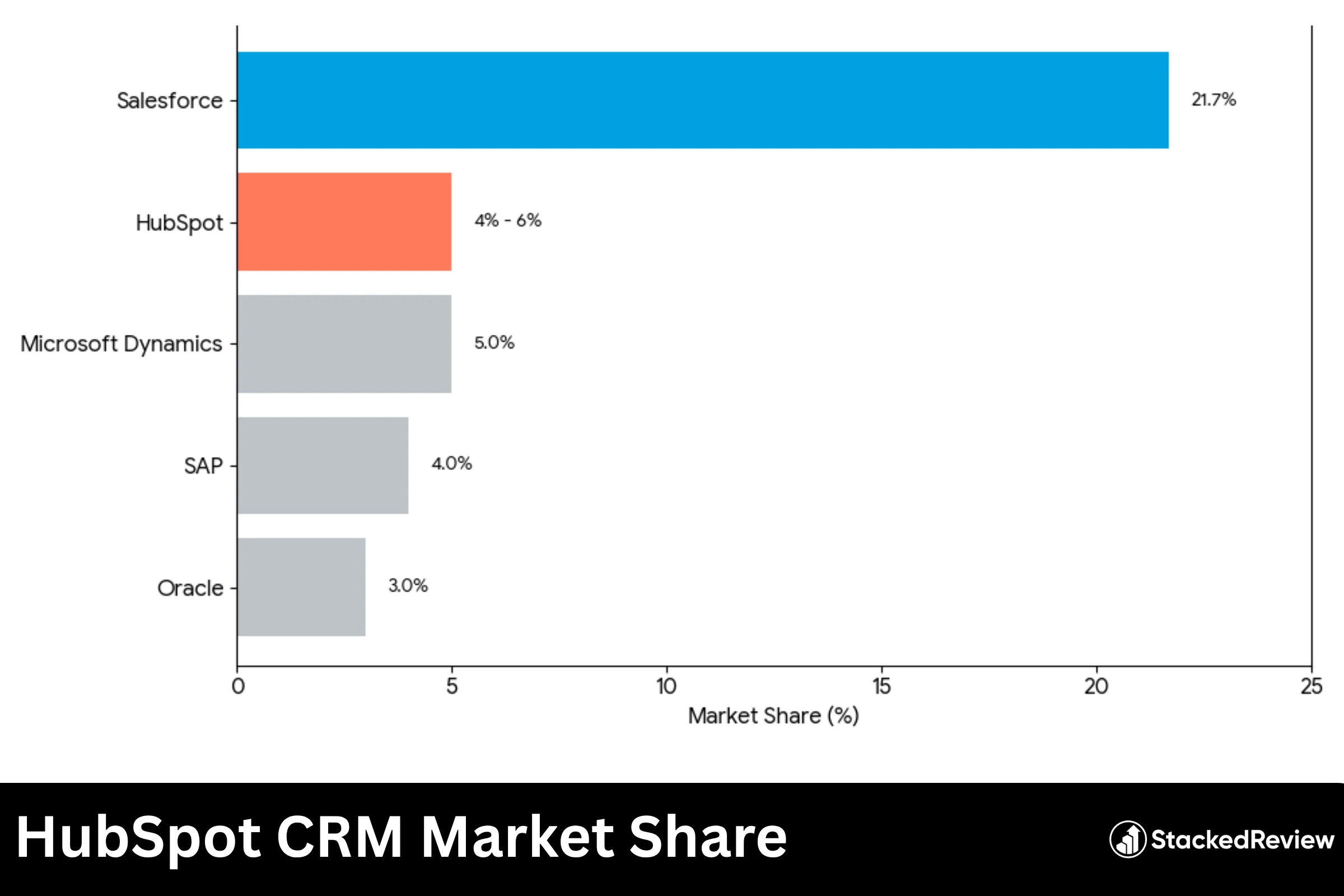
Salesforce still leads the global CRM software market with a 21.7% to 21.8% market share. HubSpot’s overall CRM market share sits at an estimated 4% to 6% globally.
But in the SMB and mid-market CRM segment, HubSpot’s share is significantly higher. Among technology companies, startups and digital-first businesses, HubSpot has become a default choice.
| CRM Vendor | Global Market Share | Key Strength |
|---|---|---|
| Salesforce | 21.7% | Largest ecosystem, AI tools |
| Microsoft Dynamics | ~5% | Office 365 integration |
| SAP | ~4% | Enterprise ERP bundling |
| Oracle | ~3% | Database and cloud infrastructure |
| HubSpot | 4% to 6% | Free tier, SMB-friendly platform |
| Zoho CRM | Growing fast | Affordable, global reach |
More CRM market facts for 2026:
HubSpot is the fastest-growing major CRM vendor by revenue growth rate. While it trails Salesforce by overall share, it is closing the gap faster than any competitor.
🤖 HubSpot Marketing Automation Market Share
In marketing automation, HubSpot dominates. It holds roughly 38% of the global marketing automation software market in 2026. That makes it the number one solution by market share, ahead of Salesforce, Adobe and ActiveCampaign.
Global marketing automation industry revenue crossed $8 billion in 2024 and is on track to reach $10 billion by 2030.
Key marketing automation stats:
HubSpot’s Breeze AI, launched across its platform in 2024 and 2025, offers AI-powered content creation, lead scoring, chatbots and workflow automation. AI adoption is gathering pace, with CEO Yamini Rangan calling 2025 a year where “AI adoption gathered pace” via Breeze Customer Agent.
👨💼 HubSpot Employee and Workforce Statistics
HubSpot employs 8,882 full-time people as of 2025. Headcount has more than doubled since 2020 when it stood at 4,225.
| Year | Total Employees | Year-over-Year Change |
|---|---|---|
| 2017 | 2,081 | — |
| 2018 | 2,638 | +557 |
| 2019 | 3,387 | +749 |
| 2020 | 4,225 | +838 |
| 2021 | 5,895 | +1,670 |
| 2022 | 7,433 | +1,538 |
| 2023 | 7,663 | +230 |
| 2024 | 8,246 | +583 |
| 2025 | 8,882 | +636 |
Regional employee distribution:
| Region | Employees | Share of Workforce |
|---|---|---|
| Americas | 5,724 | 64.47% |
| Europe | 2,480 | 27.92% |
| Asia Pacific | 678 | 7.63% |
Hiring slowed in 2023 with just 230 new hires, likely reflecting broader tech industry caution. Hiring picked up again in 2024 and 2025 with over 1,200 combined new additions. Europe has a growing workforce, reflecting increased investment in EMEA markets.
💳 HubSpot Operating Expenses and Profitability in 2026
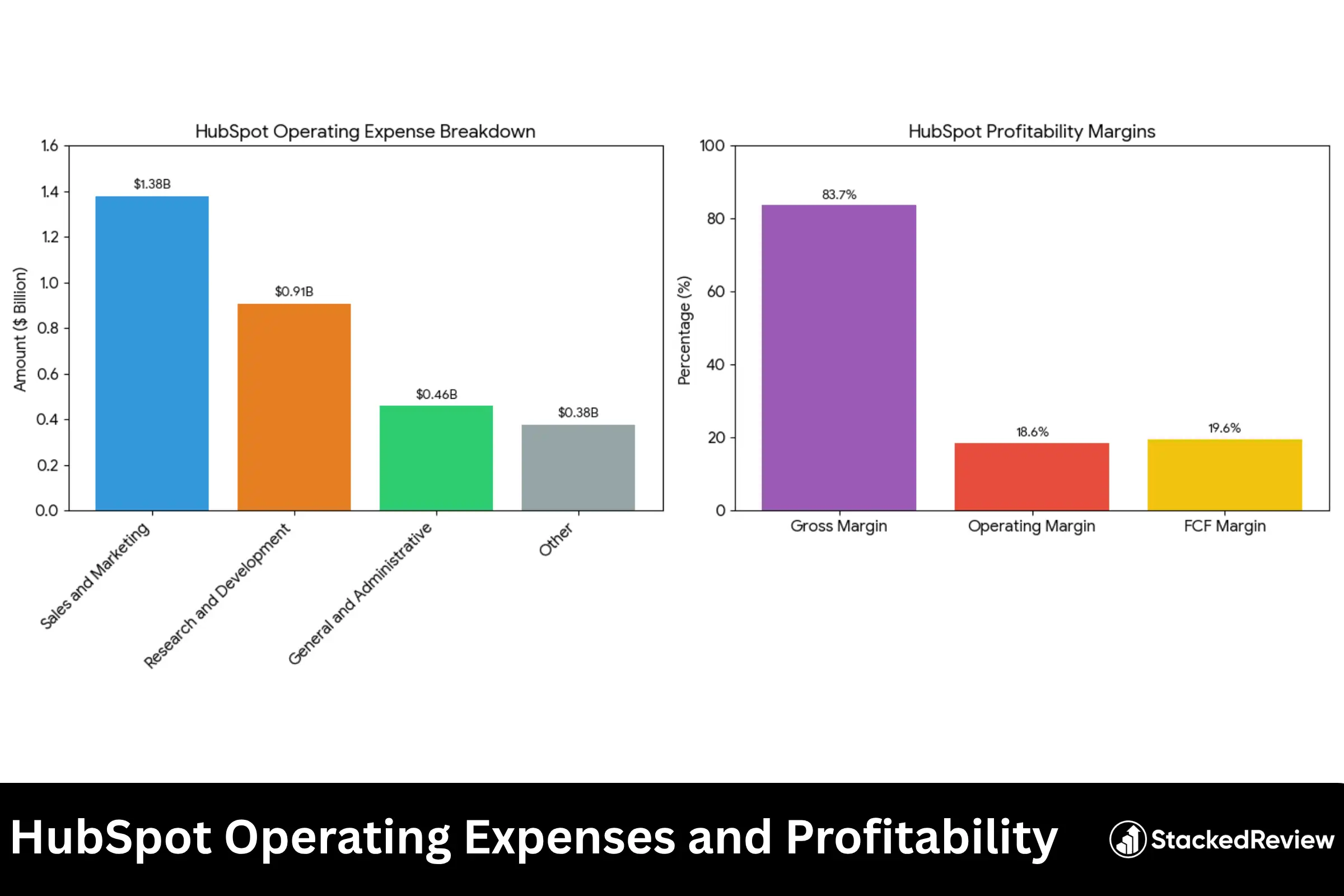
Total operating expenses reached $3.12 billion in 2025, a 15.91% increase from 2024.
| Expense Category | 2025 Amount | % of Total |
|---|---|---|
| Sales and Marketing | $1.38 billion | 44.17% |
| Research and Development | $905.94 million | 29.02% |
| General and Administrative | $458.66 million | 14.68% |
| Total | $3.12 billion | 100% |
Profitability metrics are improving:
Sales and marketing spend has dropped from 67.13% of total expenses in 2010 to 44.17% in 2025. This declining percentage signals improved efficiency. HubSpot is acquiring customers at lower relative cost even as absolute spending rises.
R&D investment of $905.94 million shows HubSpot pours heavy resources into product development, AI features and new hub launches. R&D grew 16.33% year over year.
🏆 HubSpot ROI and Marketing Performance Stats
Return on investment is where HubSpot stands out. Businesses using HubSpot Marketing Hub report an average 505% ROI over three years.
More performance numbers:
Email marketing campaigns through HubSpot achieve open rates between 20% and 30%. Personalised email campaigns drive a 20% increase in sales.
🔍 HubSpot SEO and Content Marketing Stats
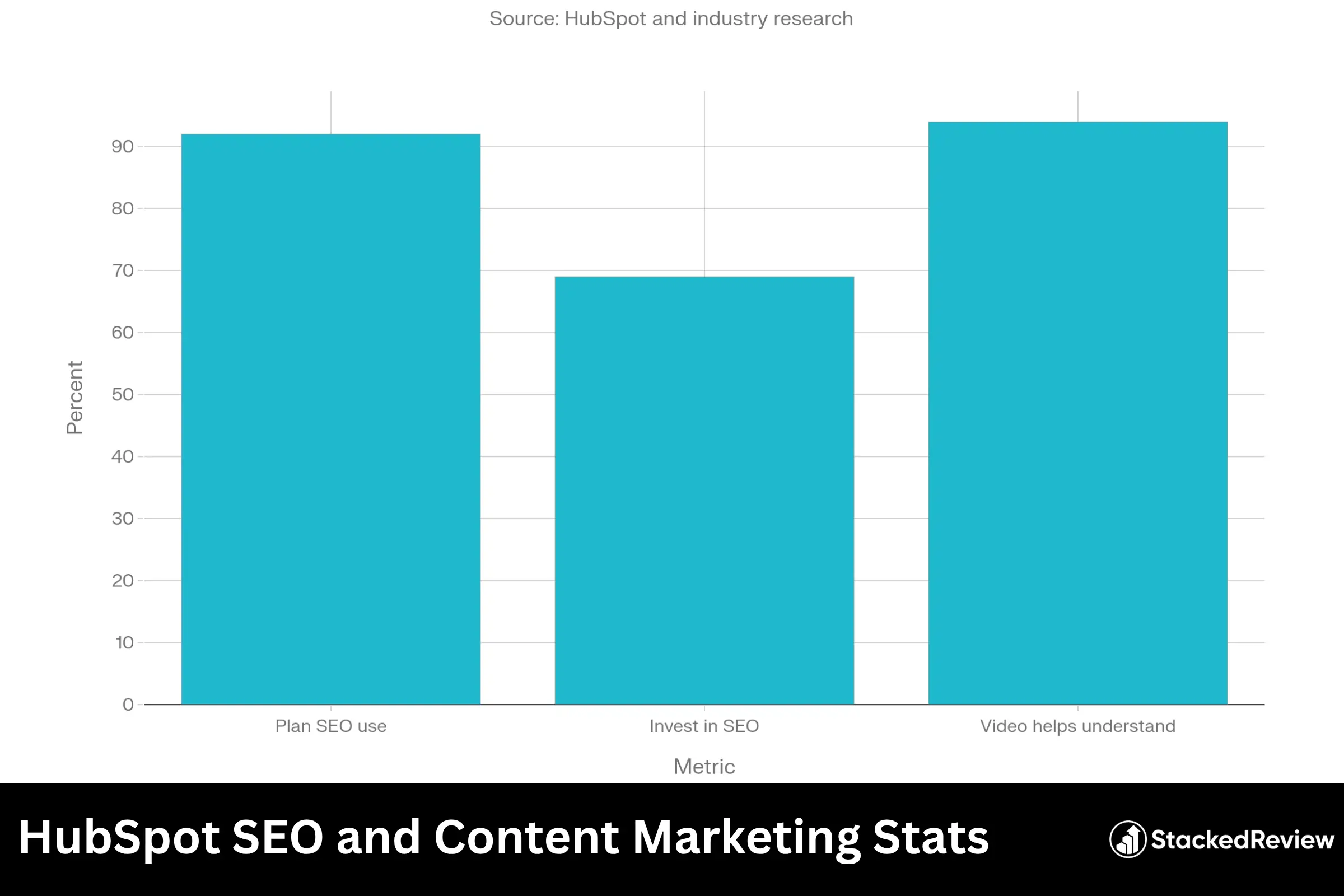
Search engine optimization remains a core part of how HubSpot users drive traffic. Around 92% of marketers plan to use SEO optimisation for traditional and AI-powered search engines in 2026.
Content and SEO performance stats:
HubSpot’s built-in SEO strategy tools let marketers manage keyword strategies, meta descriptions and topic clusters from one dashboard.
🎥 HubSpot Social Media and Video Stats
Video accounts for over 82% of all online traffic according to HubSpot data. Social media platforms remain critical for lead generation.
🤝 HubSpot vs Salesforce in 2026
HubSpot and Salesforce are the two most compared CRM platforms. Here is how they compare in 2026:
| Metric | HubSpot (2026) | Salesforce (2026) |
|---|---|---|
| Projected Revenue | $3.69 to $3.70 billion | $41.45 to $41.55 billion |
| Revenue Growth Rate | 18% to 20% | 8% to 11% |
| Paying Customers | ~290,000+ | 150,000+ |
| Average Revenue Per Customer | ~$11,400 | ~$250,000+ |
| CRM Market Share | 4% to 6% | 21.7% |
| Marketing Automation Share | 38% | ~15% |
| Strongest Segment | SMB and Mid-Market | Enterprise |
| Free CRM Tier | Yes | No |
HubSpot serves far more customers at lower price points. Salesforce generates higher average revenue per account due to enterprise pricing. Growth rate is where HubSpot wins clearly, gaining ground faster than any other major CRM vendor.
Salesforce’s failed acquisition attempt of HubSpot in 2024, reportedly at a $40+ billion valuation, showed how seriously the industry views HubSpot as a competitive threat.
🔗 HubSpot Ecosystem and Integration Stats
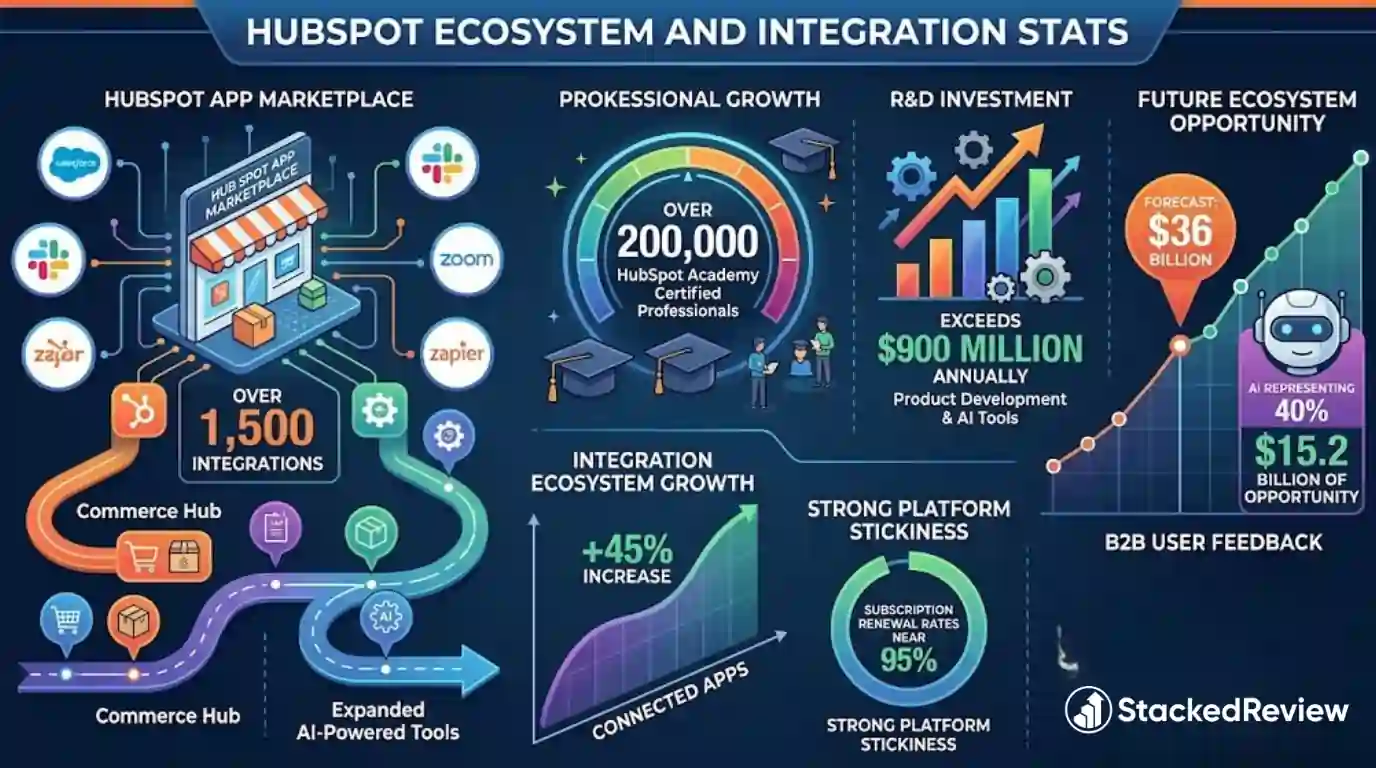
HubSpot’s App Marketplace offers over 1,500 integrations. From Salesforce to Slack, Zoom to Zapier, businesses can centralise data and automate processes across marketing, sales and service.

📊 HubSpot Financial Snapshot for 2026
Here is a consolidated look at HubSpot’s financial position entering 2026:
| Financial Metric | Value |
|---|---|
| 2025 Total Revenue | $3.13 billion |
| 2026 Revenue Guidance | $3.69 to $3.70 billion |
| 2026 Revenue Growth (Projected) | ~18% |
| 2025 Subscription Revenue | $3.07 billion |
| 2025 Operating Margin (Full Year) | 18.6% |
| 2025 Operating Margin (Q4) | 22.6% |
| 2025 Gross Margin | 83.7% |
| 2026 EPS Guidance | $12.38 to $12.46 |
| Q4 2025 Calculated Billings | $971.4 million |
| Estimated 2026 Free Cash Flow | ~$704 million |
| Paying Customers (End of 2025) | 288,706 |
| Average Revenue Per Customer | $11,414 |
| Total Employees | 8,882 |
| Countries Served | 135+ |
| App Marketplace Integrations | 1,500+ |
| Marketing Automation Market Share | ~38% |
| CRM Market Share | 4% to 6% |
| Global CRM Market Size (2026) | $109.07 billion |
HubSpot now serves nearly 290,000 customers with close to 9,000 employees globally. Revenue is growing at nearly double the rate of market leader Salesforce. Operating margins are expanding as scale efficiencies take hold.
Analyst firms like Citi, Bernstein and Needham maintain Buy ratings on HubSpot stock, citing strong revenue growth, improving margins and AI-driven product momentum. For marketers evaluating CRM and marketing automation platforms in 2026, HubSpot’s numbers speak for themselves.
Sources
- HubSpot Investor Relations — Q4 and Full Year 2025 Results
- Statista — CRM Software Worldwide Market Forecast, 2026
- Statista — Marketing Automation Statistics and Facts
- Hublead — Essential HubSpot Statistics, 2026
- AFFiNCO — CRM Statistics for 2026
- HubSpot — 2026 Marketing Statistics, Trends and Data
- Yahoo Finance — HubSpot Q4 and Full Year 2025 Earnings
- MarketBeat — HubSpot Earnings Date and Reports 2026
- StocksToTrade — HubSpot Analyst Price Target Updates, February 2026
- IDC via HubSpot — HubSpot Ecosystem Revenue Opportunity Forecast
Affiliate Disclosure: This post may contain some affiliate links, which means we may receive a commission if you purchase something that we recommend at no additional cost for you (none whatsoever!)
Similar Posts






Verification process
Editorial standards
We’re a team of real users — not bots, not press-release copiers. Here’s exactly how we earn your trust on every single post.
We Actually Buy the Products
Every deal on this site is tested with a real purchase using our own accounts. We don’t rely on screenshots sent by vendors or press kits. If we say the discount works, we’ve clicked through checkout ourselves.
No Pay-to-Rank Policy
We never accept payment to feature or rank a deal higher. Affiliate commissions don’t influence our editorial scores — a bad deal stays ranked low regardless of commission size.
Monthly Re-Verification
Pricing changes fast. Our team re-tests every published deal at least once a month and immediately updates or removes any that have expired, changed, or been capped.
Expert Editorial Team
Our writers and editors have collectively spent 40,000+ hours hands-on with digital tools. We know what a fair price looks like — and we call out bad deals even when they’d earn us commissions.
Transparent Scoring Criteria
Every score is calculated from a public rubric: discount value, feature-to-price ratio, redemption ease, plan flexibility, and competitor comparison. No hidden weighting, ever.
Reader Feedback Loop
Thousands of readers report broken deals each month. Our team investigates every report within 24 hours and updates the page the same day a deal stops working.
Jaclyn Donaldson
Jaclyn is a content strategist at StackedReview with a passion for empowering small businesses. She specializes in dissecting social media advertising costs and hunting down the best-value deals. Her goal is to help brands stretch their budget further without compromising on results.