
Salesforce Statistics for 2026: Revenue, Market Share and More

By :
Jaclyn Donaldson
April 14, 2026

Salesforce continues to dominate the global CRM market in 2026 with record-breaking revenue and aggressive AI investments. From a $5 million startup in 2001 to a $41+ billion enterprise powerhouse, Salesforce has reshaped how businesses manage customer relationships.
These updated Salesforce statistics for 2026 cover revenue, market share, employees, AI adoption and much more. Every number here matters if you run a business or market one. Let’s get straight into the data.
Salesforce Revenue Statistics That Show Massive Growth 💰
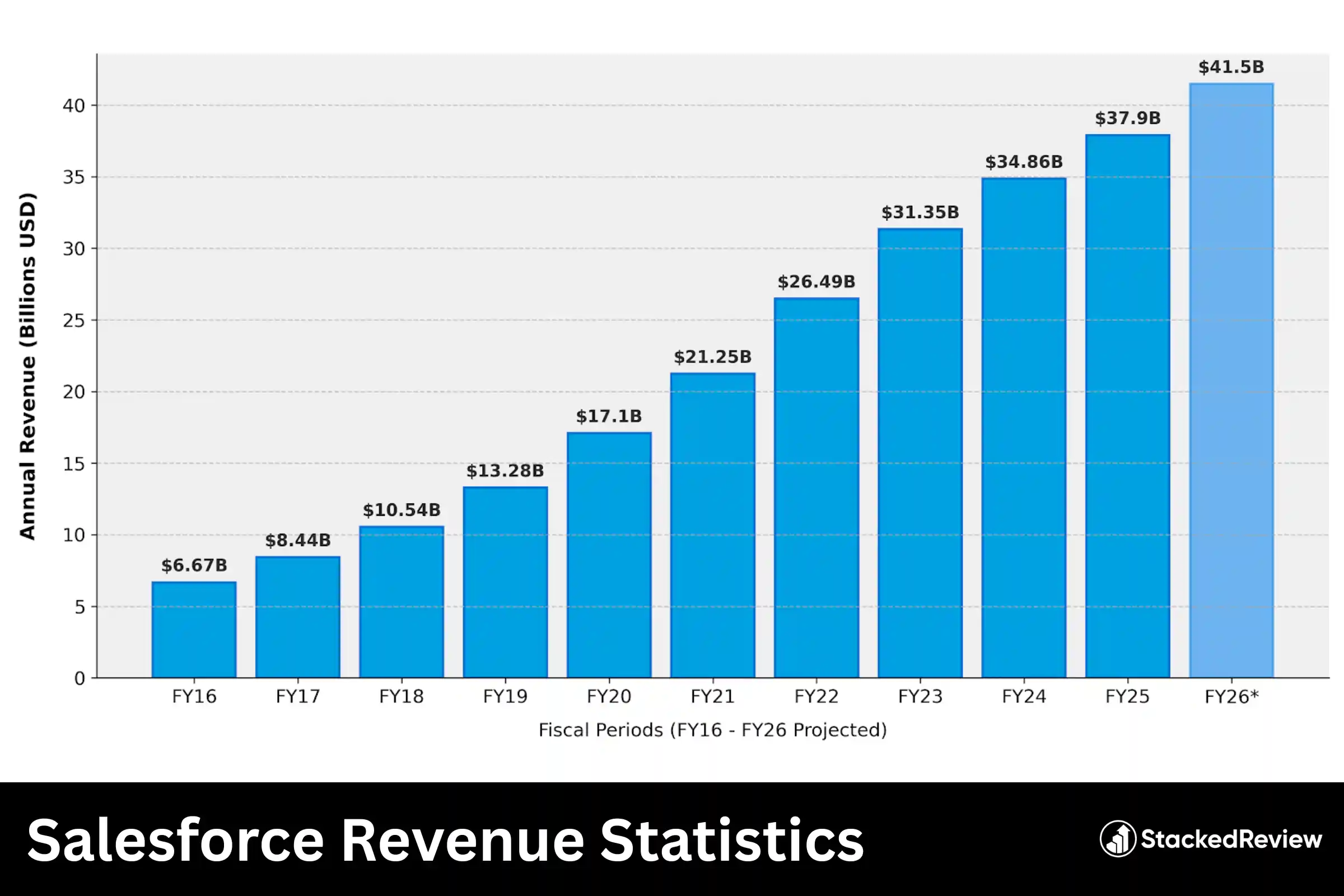
Salesforce posted annual revenue of $37.9 billion in fiscal year 2025. That is a 9% jump over FY2024. Revenue has grown every single year since the company started.
For fiscal year 2026, Salesforce guided revenue between $41.45 billion and $41.55 billion. FY2026 Q4 alone brought in $11.20 billion, up 12% year over year.
Here is a look at Salesforce annual revenue over the past decade:
| Fiscal Year | Annual Revenue |
|---|---|
| 2016 | $6.67 billion |
| 2017 | $8.44 billion |
| 2018 | $10.54 billion |
| 2019 | $13.28 billion |
| 2020 | $17.1 billion |
| 2021 | $21.25 billion |
| 2022 | $26.49 billion |
| 2023 | $31.35 billion |
| 2024 | $34.86 billion |
| 2025 | $37.9 billion |
| 2026 (Projected) | $41.45 to $41.55 billion |
Since 2020, Salesforce revenue has increased by 121.63%. That kind of growth over five years is rare for a company of this size. Long-term targets suggest Salesforce aims to reach $63 billion in annual revenue by FY2030 .
Revenue growth has averaged roughly 12.9% annually over recent fiscal periods. Most of it comes from subscription and support contracts, which make up 94.2% of total revenue.
How Salesforce Earns Its Billions: Revenue by Segment
Salesforce splits revenue into two main buckets. Subscription and support is the first. Professional services and other revenue is the second.
Subscription and support revenue hit $35.7 billion in FY2025. That is a 10% increase over FY2024. Revenue from subscriptions has more than doubled in just five years.
Professional services and other revenue totalled $2.22 billion in FY2025. It accounts for roughly 6% of total income.
| Segment | FY2025 Revenue | Share of Total |
|---|---|---|
| Subscription and Support | $35.7 billion | 94.2% |
| Professional Services and Other | $2.22 billion | 5.8% |
| Total | $37.9 billion | 100% |
Subscription-based recurring revenue keeps cash flows predictable and steady. It is the backbone of the Salesforce business model and what makes investors confident about future growth.
Salesforce Revenue by Cloud Product: Where Does Money Come From? ☁️
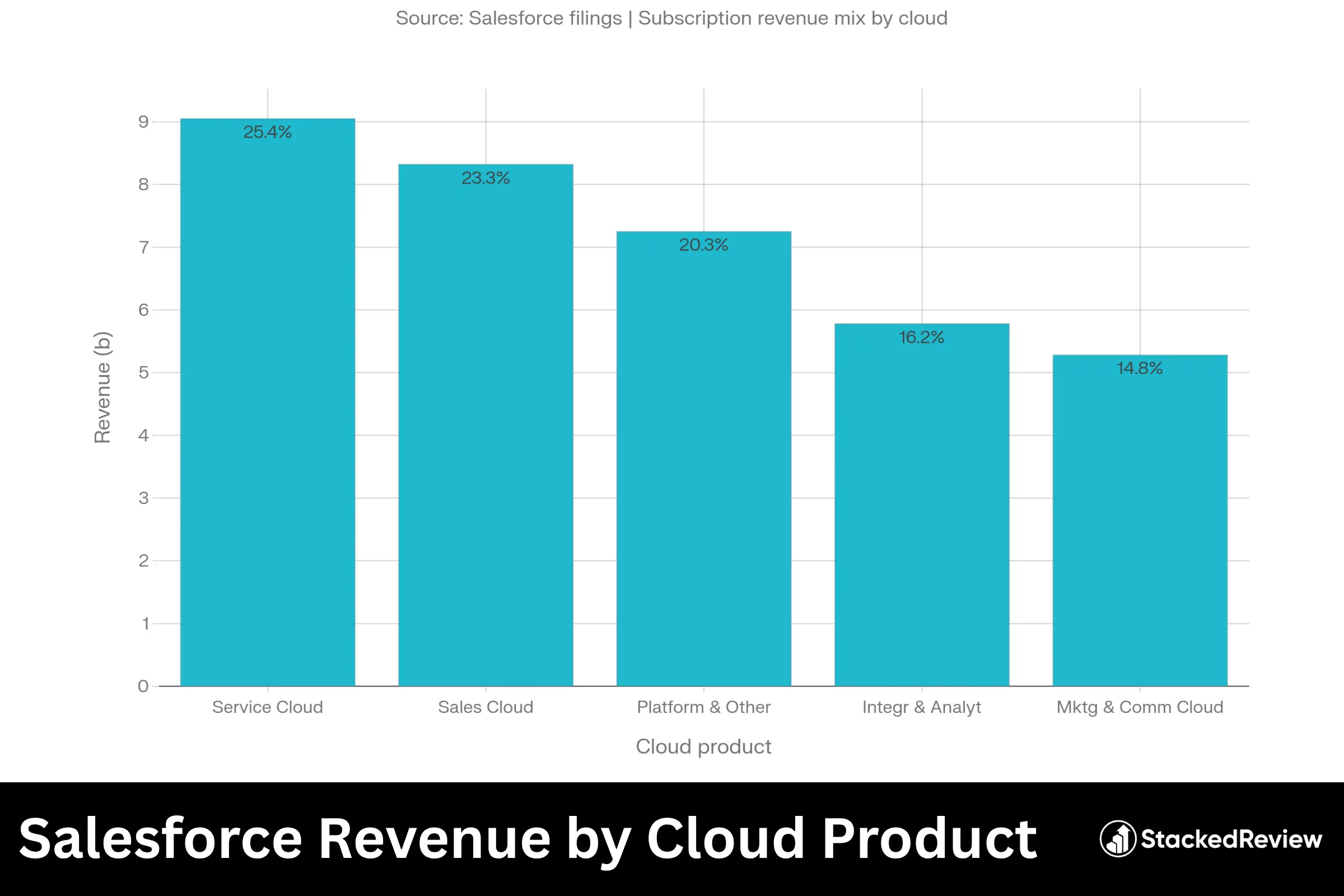
Salesforce breaks down subscription revenue across five major cloud products. Each one targets a different area of business operations.
| Cloud Product | FY2025 Revenue | Share of Subscription Revenue |
|---|---|---|
| Service Cloud | $9.05 billion | 25.4% |
| Sales Cloud | $8.32 billion | 23.3% |
| Platform and Other (incl. Slack) | $7.25 billion | 20.3% |
| Integration and Analytics (MuleSoft, Tableau) | $5.78 billion | 16.2% |
| Marketing and Commerce Cloud | $5.28 billion | 14.8% |
Service Cloud is the largest revenue generator at $9.05 billion. It grew 9.81% over FY2024. Companies use Service Cloud to manage customer support, case routing and service automation.
Sales Cloud brought in $8.32 billion in FY2025. It helps businesses automate sales pipelines, manage leads and close deals faster.
Platform and Other revenue, which includes Slack and AppExchange ecosystem fees, reached $7.25 billion. Integration and Analytics, covering MuleSoft and Tableau, generated $5.78 billion.
Marketing and Commerce Cloud contributed $5.28 billion. It grew 7.51% over the prior year and accounts for 15% of all subscription revenue.
Data Cloud and AI-related annual recurring revenue reached approximately $900 million in FY2025. By FY2026 Q3, Agentforce and Data Cloud AI combined ARR surpassed $1.4 billion. That shows how fast AI-powered CRM features are gaining traction.
Salesforce Market Share: Still the Undisputed CRM Leader 🏆
Salesforce holds a 21.7% share of the global CRM applications market in 2026. It has been the number one CRM provider according to IDC for 12 consecutive years.
No other vendor comes close. Salesforce’s market share is larger than Oracle, SAP and Microsoft combined.
| CRM Vendor | Market Share | Key Strength |
|---|---|---|
| Salesforce | 21.7% | Largest ecosystem, AI integration |
| Microsoft Dynamics 365 | ~5.2% | Office 365 integration |
| Oracle | ~4.1% | Enterprise database integration |
| HubSpot | ~3.4% to 5.6% | SMB-friendly, freemium model |
| SAP | ~3.1% | Large enterprise focus |
| Zoho | Growing | Affordable, global reach |
The combined market share of the top four vendors totals 75%. That leaves about 25% split across hundreds of smaller CRM providers.
Salesforce CRM market dominance is built on ecosystem size, product breadth and aggressive AI investment. More than 83% of Fortune 500 companies use at least one Salesforce app.
How Many Companies Use Salesforce in 2026? 🌍
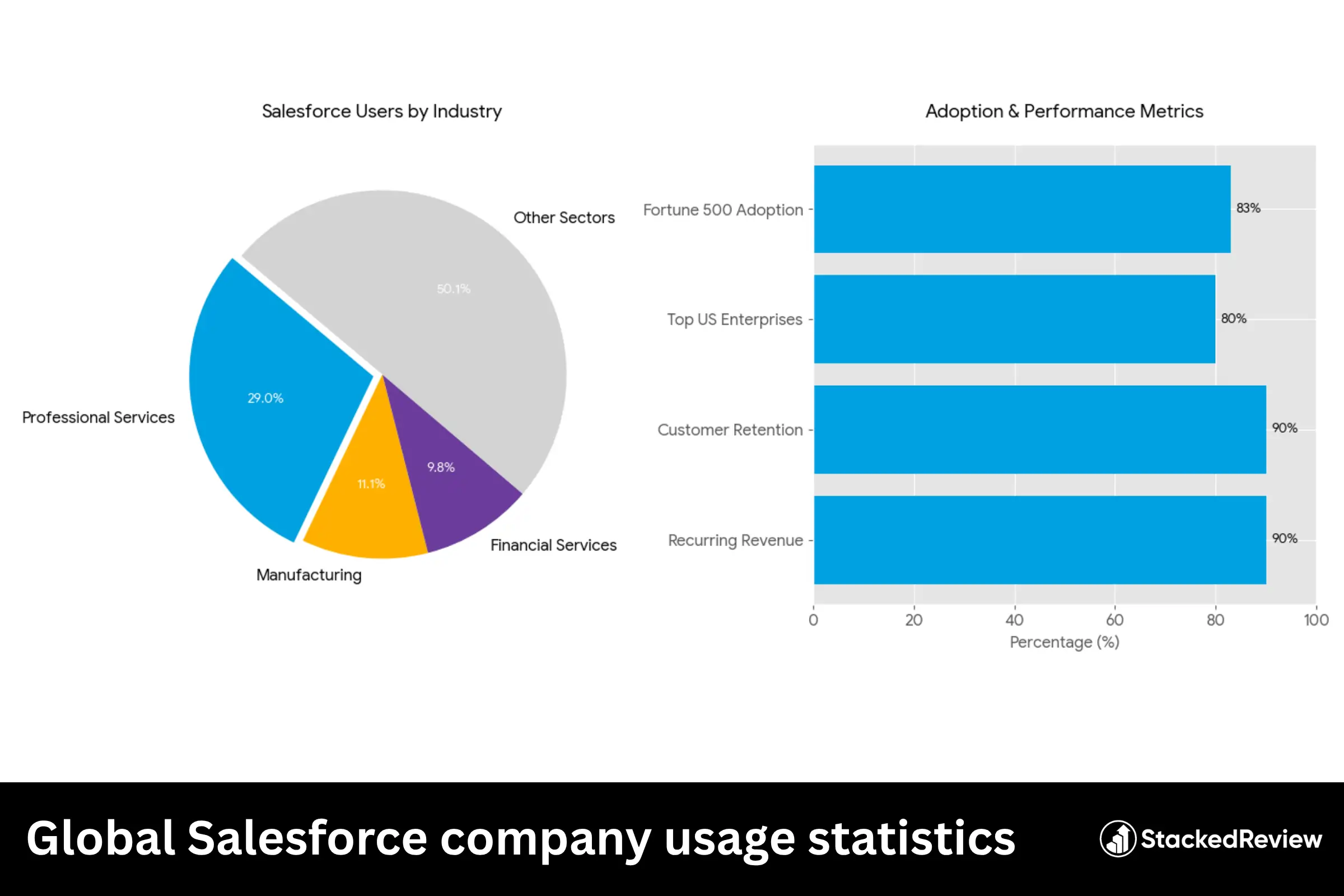
Over 150,000 companies worldwide use Salesforce solutions. These range from small startups to the biggest enterprises on the planet.
Key customer stats:
Professional services make up 29% of Salesforce users. That is the largest single industry segment. Manufacturing accounts for 11.1%. Financial services represent 9.8%.
Small and mid-sized businesses contribute over 50% of new Salesforce customers. They primarily use Essentials and Professional editions due to flexible pricing.
Salesforce Revenue by Region: Where Growth Is Happening
The Americas remain the largest market for Salesforce. But international growth is picking up speed.
| Region | FY2025 Revenue | Share of Total |
|---|---|---|
| Americas | $25.14 billion | 66% |
| Europe | $8.89 billion | 24% |
| Asia Pacific | $3.86 billion | 10% |
Americas revenue exceeded $25 billion for the first time in FY2025. Europe crossed $8.89 billion, driven by cloud adoption in financial services and manufacturing sectors.
Asia Pacific is the fastest-growing region with revenue crossing $3.86 billion. Markets like Japan, Australia and India are driving double-digit annual growth. Emerging markets in Southeast Asia show increasing CRM adoption among mid-sized businesses.
Currency fluctuations reduced reported international revenue growth by roughly 1% to 2%.
Salesforce Profitability: From Losses to Billions in Profit 📈
Salesforce has turned into a profit machine. After years of losses in its early days, the company now generates billions in net income.
| Fiscal Year | Net Income |
|---|---|
| 2019 | $1.11 billion |
| 2020 | $126 million |
| 2021 | $4.07 billion |
| 2022 | $1.44 billion |
| 2023 | $208 million |
| 2024 | $4.14 billion |
| 2025 | $4.1 billion |
FY2024 saw record-breaking net income of $4.14 billion. FY2025 stayed strong at $4.1 billion. GAAP operating margin improved to approximately 19% in FY2025.
Non-GAAP operating margin reached 31% in FY2025, up from 27% in FY2024. Free cash flow totalled $9.5 billion, supporting shareholder returns. Operating cash flow hit $13.1 billion, up 28% year over year.
Salesforce maintained over $13 billion in cash and cash equivalents at year end. Subscription and support gross margin remained above 80%.
Salesforce Stock and Valuation Numbers 📉
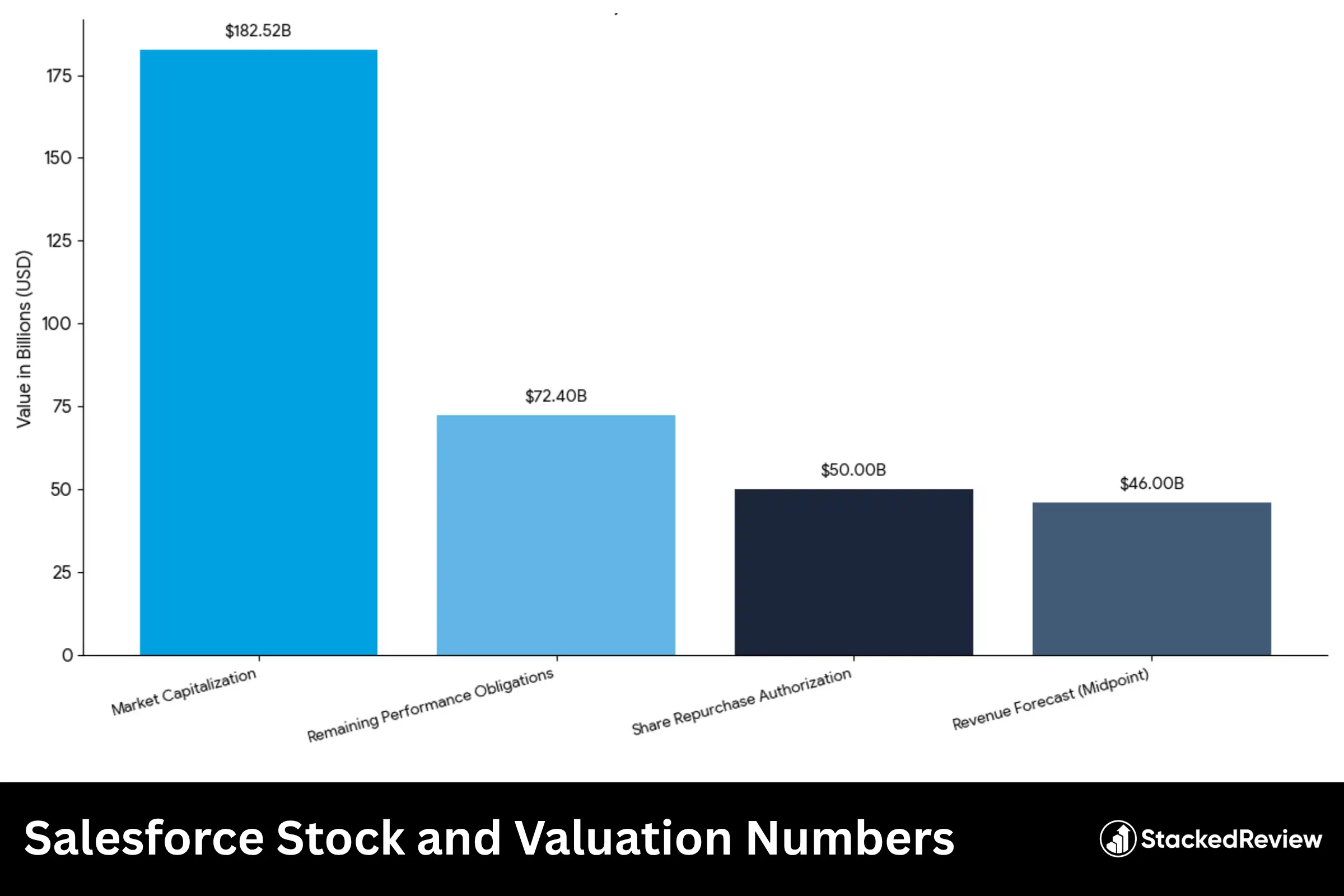
Salesforce’s market capitalisation stands at $182.52 billion as of February 2026. It trades on the NYSE under the ticker CRM.
Key stock and valuation stats:
Salesforce is the second-largest SaaS company on US stock exchanges by market cap, behind Palantir Technologies as of March 2026. It is also ranked 18th among America’s Best Large Employers in 2026.rankings.
The company forecasted FY2027 revenue between $45.8 billion and $46.2 billion.
Salesforce Employee and Workforce Stats 👥
Salesforce had 83,334 employees as of January 31, 2026. That is the official figure from the company’s latest annual report.
Here is how headcount has changed over recent years:
| Fiscal Year | Number of Employees |
|---|---|
| 2019 | 35,000 |
| 2020 | 49,000 |
| 2021 | 56,606 |
| 2022 | 73,541 |
| 2023 | 79,390 |
| 2024 | 72,682 |
| 2025 | 76,453 |
| 2026 | 83,334 |
Around 51% of employees are based in the United States. The remaining 49% work across international offices in over 30 countries.
Salesforce’s workforce ballooned from 48,000 before the pandemic to nearly 80,000 during the remote work boom. In September 2025, Salesforce eliminated 4,000 customer support positions because AI was handling up to 50% of work.
In early February 2026, Salesforce cut fewer than 1,000 additional roles across marketing, product management, data analytics and AI teams. CEO Marc Benioff acknowledged that workforce reductions were linked to growing use of artificial intelligence.
The median base salary for Salesforce employees in the US on an H1-B visa is $168,000.
Salesforce AI and Agentforce Adoption Stats 🤖
AI is at the centre of Salesforce’s growth story in 2026. The company has invested heavily in AI-powered tools like Agentforce, Einstein AI and Data Cloud.
Key Salesforce AI statistics for 2026:
Salesforce acquired Informatica for $8 billion to strengthen data and AI capabilities. Data Cloud processes billions of customer records daily. These records power AI-driven personalisation across Sales, Service and Marketing Cloud.
Generative AI capabilities integrated into CRM workflows are increasing sales team productivity across industries.
Salesforce ROI and Business Impact Numbers
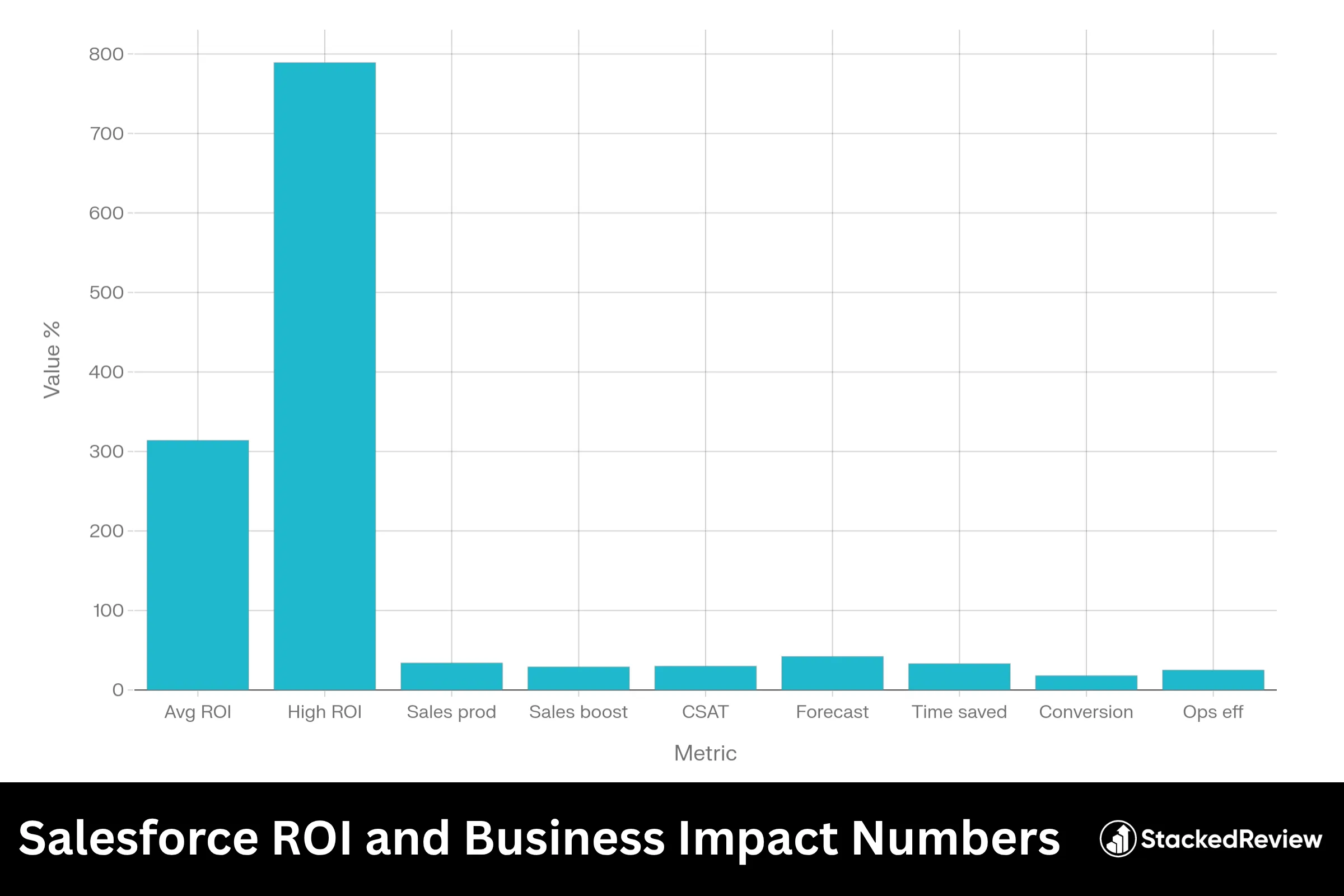
Businesses using Salesforce see measurable returns. The numbers on Salesforce CRM return on investment are hard to ignore.
| Metric | Value |
|---|---|
| Average ROI | 314% |
| High-adoption ROI | Up to 789% |
| Sales productivity increase | 34% |
| Sales boost via pipeline management | Up to 29% |
| Customer satisfaction improvement | 30% |
| Forecast accuracy improvement | 42% |
| Time saved with Customer 360 | 33% |
| Conversion increase from targeted campaigns | 18% |
| Operational efficiency gains | 25% |
Companies using Salesforce achieve 34% higher sales productivity through automation and efficiency. Forecast accuracy improves by 42% with Salesforce’s customer visibility tools.
High Salesforce utilisation yields 2.5 times more payback than average CRM ROI. Sales teams save 33% of time using Customer 360 for data reconciliation across departments.
Salesforce Adoption by Industry: Who Uses It Most?
Salesforce is used across every major industry. Some sectors adopt it more heavily than others.
| Industry | Share of Salesforce Users |
|---|---|
| Professional Services | 29% |
| Manufacturing | 11.1% |
| Financial Services | 9.8% |
| Retail and Consumer Goods | Growing rapidly |
| Healthcare | Accelerating |
| Technology and SaaS | Heavy adopters |
Professional services account for 29% of all Salesforce users. It is the largest single industry segment. These firms use Salesforce for project management, client tracking and billing workflows.
Over 90% of Fortune 500 financial services and banking firms rely on Salesforce. Health Cloud adoption is accelerating because 80% of patients report difficulty navigating care, pushing hospitals toward better CRM tools.
Retail and consumer goods firms using Commerce Cloud have seen double-digit revenue growth. Manufacturing firms deploy Salesforce for field service management and supply chain visibility.
US public sector agencies expanded CRM use in 2025. Education institutions using Education Cloud report 20% to 30% faster response times on recruitment actions.
Salesforce Ecosystem and AppExchange Stats
The Salesforce ecosystem extends far beyond the core product. It includes a massive network of partners, developers, apps and consultants.
Age and Demographics of Salesforce Professionals
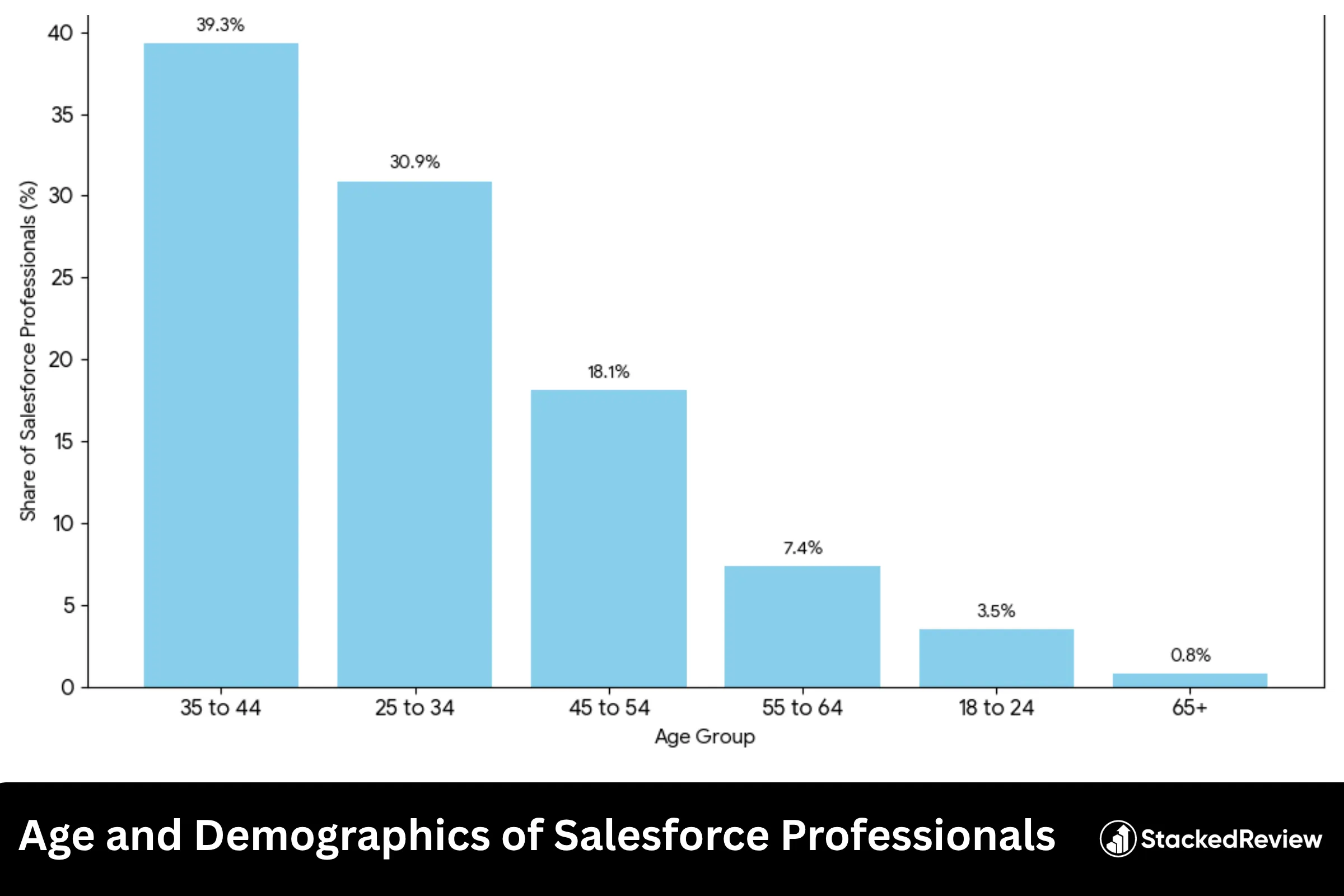
Salesforce professionals skew toward mid-career experience. Here is the age breakdown:
| Age Group | Share of Salesforce Professionals |
|---|---|
| 18 to 24 | 3.5% |
| 25 to 34 | 30.9% |
| 35 to 44 | 39.3% |
| 45 to 54 | 18.1% |
| 55 to 64 | 7.4% |
| 65+ | 0.8% |
The 35 to 44 age group is the largest at 39.3%. Combined, professionals aged 25 to 44 make up 70.2% of the talent pool. Entry-level professionals aged 18 to 24 account for just 3.5%.
More than 64.8% of Salesforce professionals are aged 35 and above. The workforce is maturing, which signals strong demand for experienced CRM administrators, developers and architects.
Global CRM Market Size: The Bigger Picture
Understanding the global CRM market helps put Salesforce’s dominance into context. CRM software revenue is projected to reach $109.07 billion to $126.17 billion worldwide in 2026.
| Year | Global CRM Market Size |
|---|---|
| 2024 | $101.41 billion |
| 2025 | $112.91 billion |
| 2026 | $109.07 to $126.17 billion |
| 2028 | $131.9 billion |
| 2030 | $157.53 billion |
| 2032 | $262.74 billion |
CRM is growing at a CAGR of 9.8% to 12.6% depending on the forecast. By 2032, the market could hit $262.74 billion.
Cloud-based CRM now makes up 87% of all deployments. On-premise CRM continues to decline. About 91% of businesses with 10 or more employees use a CRM system.
AI adoption in CRM has reached 83% in 2026. For every $1 invested in CRM, businesses get back an average of $8.71 in returns. Salesforce captures the largest single share of this growing pie.

What These Salesforce Stats Mean for Marketers
Salesforce is not slowing down. $41.5 billion in projected FY2026 revenue, a 21.7% CRM market share held for 12 straight years, and 150,000+ companies using it worldwide tell a powerful story.
AI tools like Agentforce already generate over $1.4 billion in ARR . With a $50 billion share buyback and a $63 billion FY2030 revenue target, Salesforce is betting big on its future.
For marketers, sales leaders and business owners, these stats make one thing clear. Salesforce CRM remains the platform to watch and the benchmark to beat in 2026 and beyond.
Sources
- Statista – Salesforce Revenue 2010 to 2025
- Statista – Salesforce Employees
- Statista – CRM Software Market Forecast
- Statista – Leading SaaS Companies 2026
- Statista – Best Large Employers USA 2026
- AFFiNCO – CRM Statistics 2026
- Girikon – How Many Companies Use Salesforce 2026
- TheStreet – Salesforce Employees 2026
- Salesforce – Official Earnings Reports
- IDC – Worldwide CRM Market Share Reports
Affiliate Disclosure: This post may contain some affiliate links, which means we may receive a commission if you purchase something that we recommend at no additional cost for you (none whatsoever!)
Similar Posts






Verification process
Editorial standards
We’re a team of real users — not bots, not press-release copiers. Here’s exactly how we earn your trust on every single post.
We Actually Buy the Products
Every deal on this site is tested with a real purchase using our own accounts. We don’t rely on screenshots sent by vendors or press kits. If we say the discount works, we’ve clicked through checkout ourselves.
No Pay-to-Rank Policy
We never accept payment to feature or rank a deal higher. Affiliate commissions don’t influence our editorial scores — a bad deal stays ranked low regardless of commission size.
Monthly Re-Verification
Pricing changes fast. Our team re-tests every published deal at least once a month and immediately updates or removes any that have expired, changed, or been capped.
Expert Editorial Team
Our writers and editors have collectively spent 40,000+ hours hands-on with digital tools. We know what a fair price looks like — and we call out bad deals even when they’d earn us commissions.
Transparent Scoring Criteria
Every score is calculated from a public rubric: discount value, feature-to-price ratio, redemption ease, plan flexibility, and competitor comparison. No hidden weighting, ever.
Reader Feedback Loop
Thousands of readers report broken deals each month. Our team investigates every report within 24 hours and updates the page the same day a deal stops working.
Jaclyn Donaldson
Jaclyn is a content strategist at StackedReview with a passion for empowering small businesses. She specializes in dissecting social media advertising costs and hunting down the best-value deals. Her goal is to help brands stretch their budget further without compromising on results.