
50+ AI SaaS Statistics for 2026 (Market Data and Key Trends)

By :
Jaclyn Donaldson
April 13, 2026
Artificial intelligence is reshaping the SaaS industry at record speed. AI SaaS market size hit $182.22 billion in 2026, growing at a 38.3% CAGR.
Over 91% of companies now use at least one AI-powered SaaS tool. Big Tech plans to spend $630 billion on AI infrastructure in 2026 alone. From startups to enterprises, AI-native software is eating into every budget line.
At StackedReview, we have tracked SaaS tools for years, and this is the fastest shift we have ever seen. Here are the latest AI SaaS statistics every marketer needs right now.
How Big Is the AI SaaS Market in 2026?
The numbers are staggering. And they keep climbing.
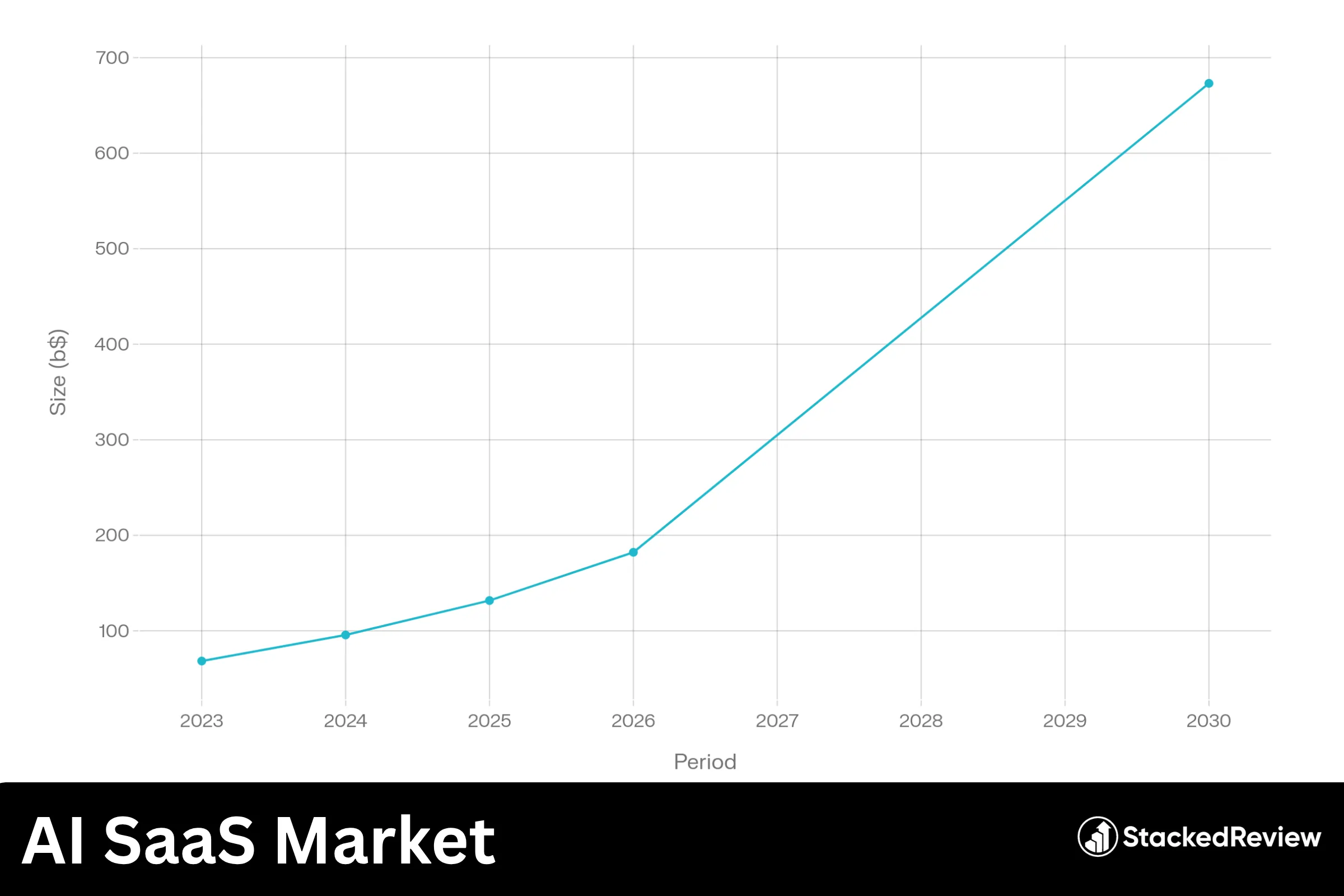
AI SaaS market size hit $182.22 billion in 2026, up from $131.73 billion in 2025. That is a 38.3% year-over-year jump. No other software category is growing at this pace. By 2030, the market is expected to reach $673.1 billion at a CAGR of 38.6%.
Here is a year-by-year look at AI SaaS market growth:
| Year | AI SaaS Market Size (USD Billion) | Growth Rate |
|---|---|---|
| 2023 | 68.4 | 32.1% |
| 2024 | 95.7 | 39.9% |
| 2025 | 131.73 | 37.6% |
| 2026 | 182.22 | 38.3% |
| 2030 | 673.1 | 38.6% CAGR |
Artificial intelligence software as a service is not a niche. It is the fastest-growing segment in cloud computing.
AI SaaS Revenue by Region
Not all markets grow at the same speed. Geography matters when planning go-to-market strategies.
North America leads with 46.2% of AI SaaS market share in 2026. The United States alone invested $109 billion in AI in 2024, which is 12 times more than China.
Asia-Pacific is the fastest-growing region. Markets like China, India, and Japan are ramping up cloud-based AI investments aggressively.
| Region | AI SaaS Market Share 2026 | Growth Rate | Key Markets |
|---|---|---|---|
| North America | 46.2% | 35.4% | U.S., Canada |
| Europe | 25.0% | 33.8% | UK, Germany, France |
| Asia-Pacific | 21.4% | 42.1% | China, India, Japan |
| Latin America | 4.8% | 38.2% | Brazil, Mexico |
| Middle East & Africa | 2.6% | 40.5% | UAE, Saudi Arabia |
Asia-Pacific shows growth above 42%. For SaaS marketers, that region offers less competition and rising demand for AI-driven SaaS solutions.
The Middle East and Africa, while small in market share, show impressive growth rates above 40%. Early movers in those regions stand to gain significant advantages.
AI Adoption Rates in SaaS Companies
Adoption is no longer a question. It is the default.
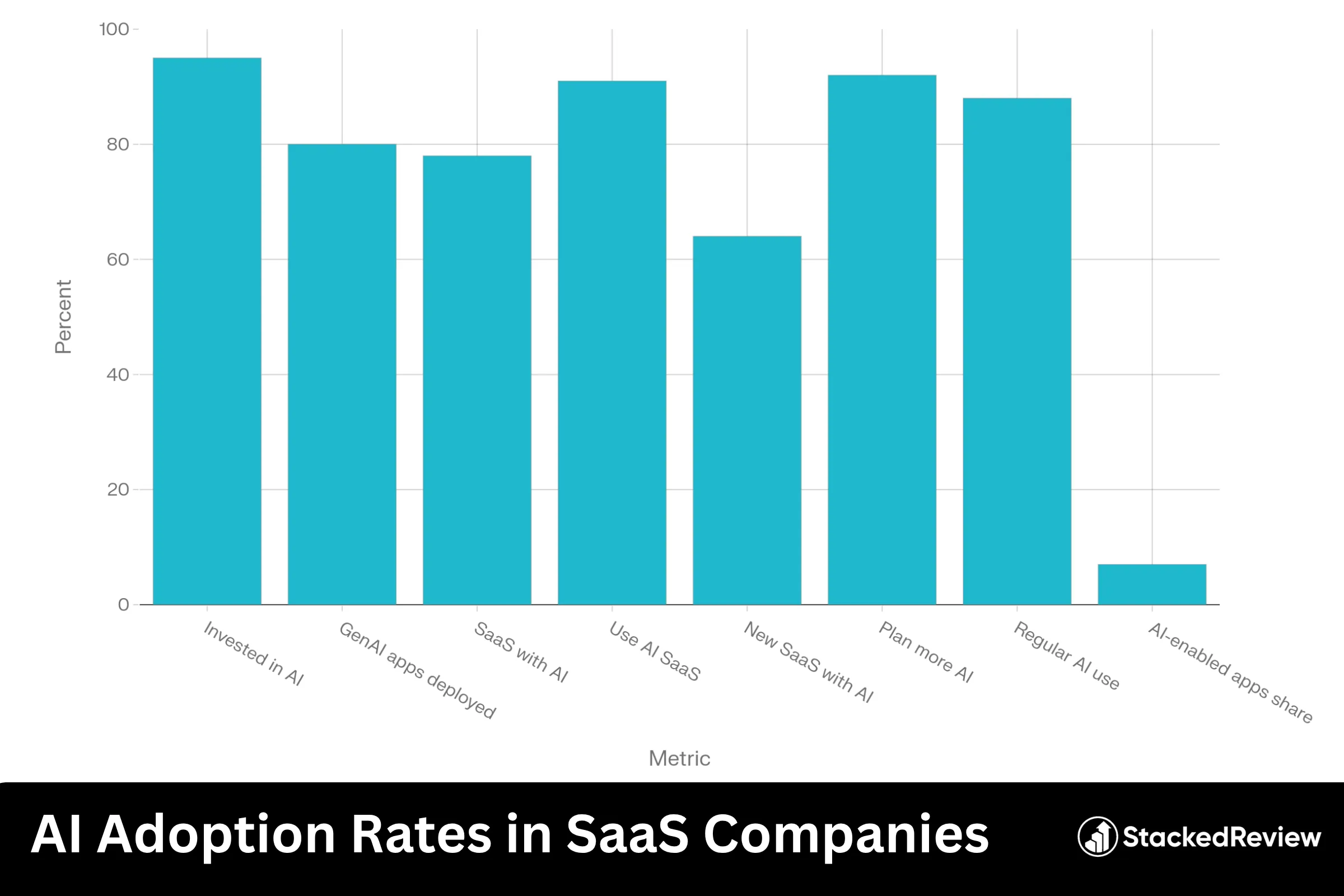
95% of organisations have now invested in AI-driven use cases. That figure stood at just 55% a year earlier, showing how quickly adoption accelerated.
Here are key AI SaaS adoption statistics for 2026:
Average organisation uses 7.3 AI-enabled SaaS apps in its stack
That last stat is worth pausing on. Only 7% of total SaaS apps are currently AI-enabled. There is massive room for growth. Every SaaS category will eventually embed AI as a core function, not a premium add-on.
For SaaS marketers, the message is clear. If your product does not have an AI story yet, you are already behind.
AI SaaS Investment and Funding Statistics
Investors are placing enormous bets on AI software companies. The funding numbers are eye-opening.
AI startups raised roughly $100 billion in just the first half of 2025. That nearly matched all of 2024’s total funding. Nearly 50% of all global startup funding now flows to AI companies.
Key investment stats:
That 4.7x revenue multiple gap is a massive signal. Public and private markets value AI-native SaaS products far higher than traditional software. If you are building or marketing SaaS without AI, your valuation takes a hit.
How AI Impacts SaaS Business Performance
Does AI actually move the needle? Yes. The ROI data is strong.
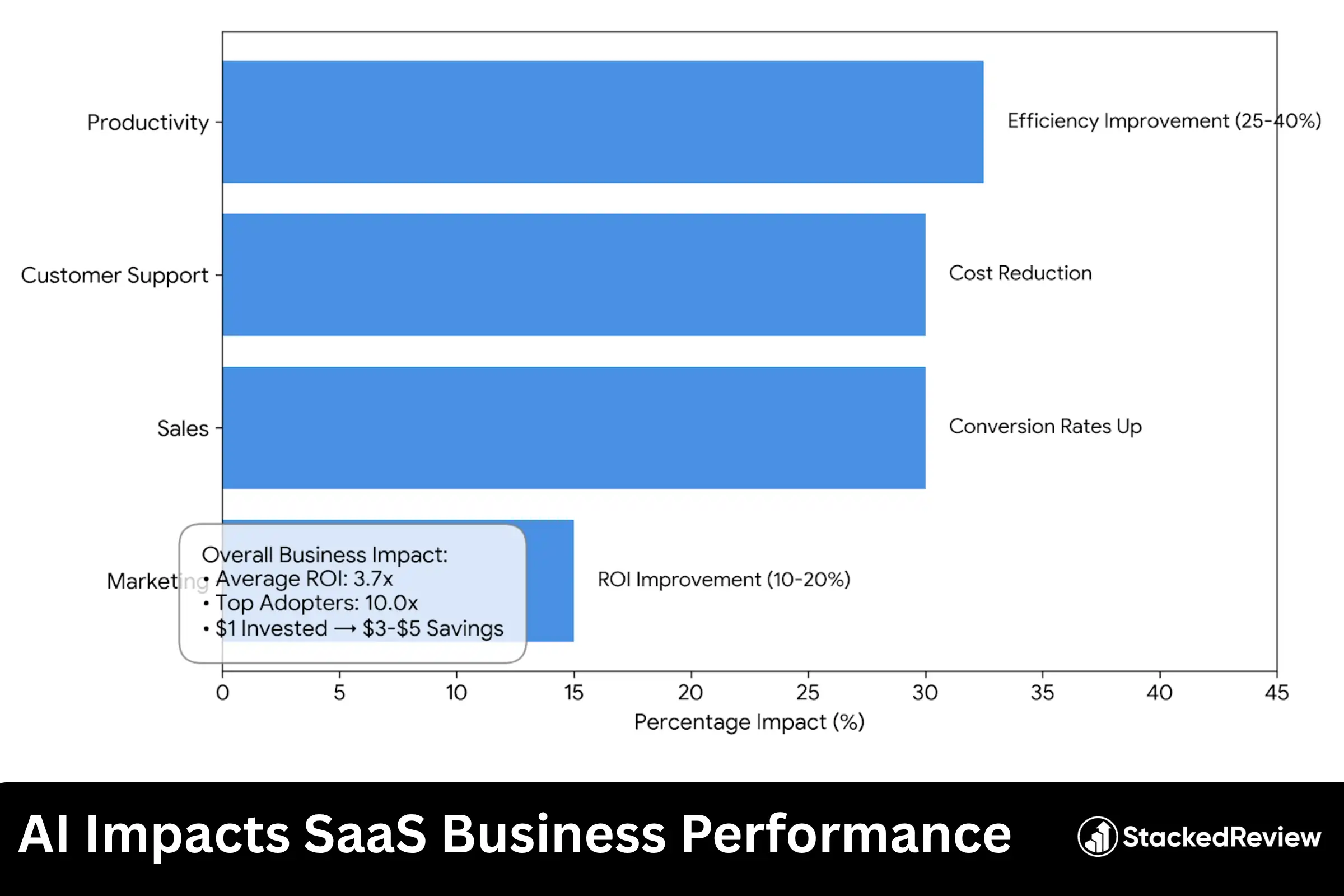
Generative AI initiatives deliver an average 3.7x ROI. Top adopters see returns as high as 10x. And 74% of companies achieve positive ROI from AI SaaS tools within the first year.
Here is how AI boosts performance across different functions:
| Function | AI Impact | Key Metric |
|---|---|---|
| Sales | Conversion rates up 30% | 81% of AI-using teams exceed revenue targets |
| Marketing | ROI improvement of 10–20% | 60% of marketers use AI tools daily |
| Customer Support | Cost reduction up to 30% | 80% use or plan AI-powered chatbots |
| Productivity | 25–40% improvement | Content creation, data analysis, service tasks |
| Overall Business | 3.7x average ROI | Top adopters see 10x returns |
95% of organisations using AI report cost savings and time efficiencies. Every $1 invested in SaaS optimisation using AI returns $3 to $5 in savings.
Those are not marginal gains. For a SaaS marketer, these stats make a compelling case in every pitch deck and sales call.
AI in SaaS by Use Case: Where It Works Best
AI is not evenly distributed across SaaS categories. Some areas see far more adoption than others.
Sales and Lead Generation
Marketing Automation
Customer Support and Success
Product Development and Operations
Customer support and sales lead in AI adoption. Marketing is catching up fast. Product development is still at an early stage but accelerating.
AI SaaS Pricing and Monetisation Trends
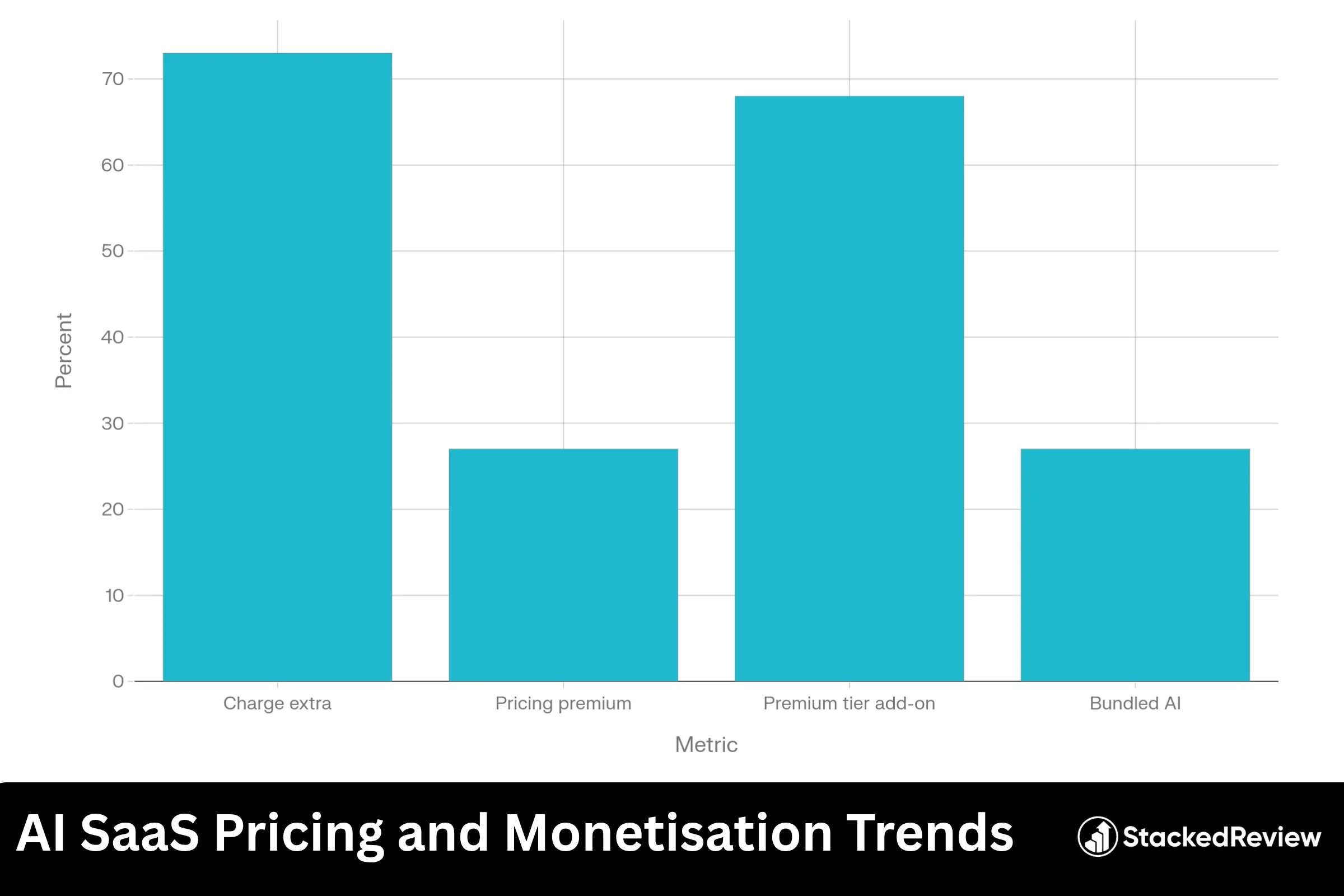
How SaaS companies charge for AI features is changing fast. And it directly affects customer acquisition and retention strategies.
| Pricing Model | Prevalence | Description |
|---|---|---|
| Premium tier add-on | 68% | AI features locked behind higher plans |
| Usage-based AI pricing | Growing | Charges based on AI queries, tokens, or outputs |
| Bundled AI features | 27% | AI included in base subscription |
| Outcome-based pricing | Emerging | Payment tied to results AI delivers |
Usage-based pricing and AI-driven consumption models are rewriting SaaS economics. For SaaS marketers, this means positioning AI features as value multipliers rather than cost increases.
Outcome-based pricing is also emerging. Customers pay based on results AI delivers rather than flat subscription fees. Expect this model to grow throughout 2026 and 2027.
AI SaaS Talent Shortage: A Growing Problem
Building AI products requires AI talent. And finding qualified professionals remains difficult.
For SaaS companies, this talent gap has direct business consequences. Product roadmaps slow down. Go-to-market timelines stretch. And competition for skilled engineers drives up costs.
Smaller SaaS firms increasingly turn to AI-as-a-Service platforms and pre-built models to bridge the gap. Rather than building from scratch, many now integrate third-party AI APIs. That approach reduces hiring pressure while keeping products competitive.
Shadow AI and Governance Challenges
AI adoption moves faster than governance in most organisations. This creates real risk.
Shadow AI is the new shadow IT. Employees adopt AI tools without IT approval because they work. But unmanaged usage creates data leakage, compliance violations, and security vulnerabilities.
For SaaS marketers selling to enterprise buyers, highlighting AI security and compliance features is now a significant differentiator. Procurement teams ask about governance before signing contracts.
45% of companies cite data quality and bias as a top challenge with AI adoption. Another 42% struggle with unclear ROI measurement and insufficient in-house expertise.
Agentic AI: The Next Big Shift in SaaS
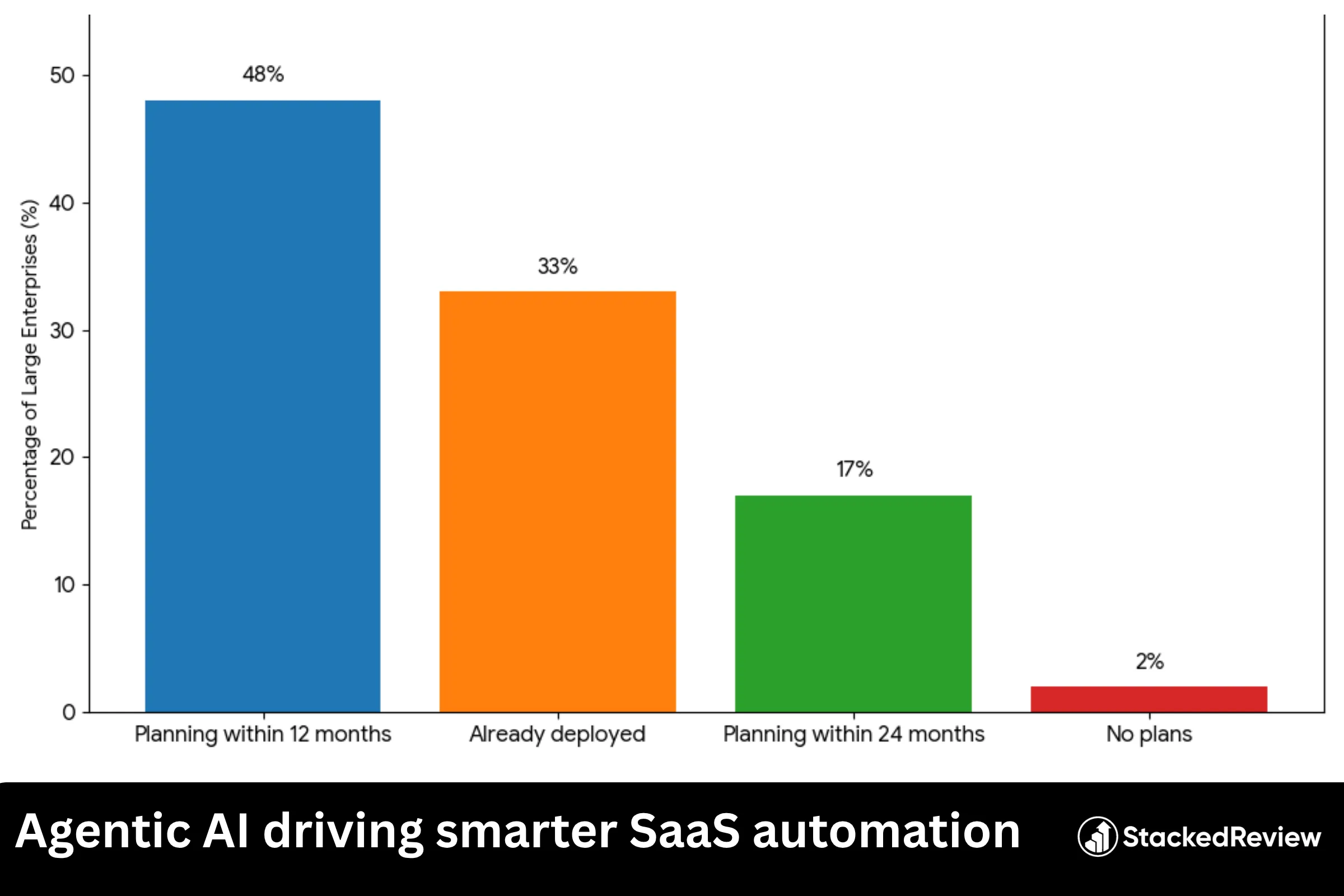
Agentic AI represents the move from copilots to autonomous agents. And enterprise adoption is accelerating fast.
| Agentic AI Adoption Stage | Percentage of Large Enterprises |
|---|---|
| Already deployed | 33% |
| Planning within 12 months | 48% |
| Planning within 24 months | 17% |
| No plans | 2% |
For SaaS marketers, agentic AI changes the conversation. You are no longer selling tools that help people work. You are selling tools that work on behalf of people. Messaging, positioning, and value propositions all need to shift accordingly.
Vertical AI SaaS Is Growing Faster Than Horizontal
Industry-specific AI SaaS is outpacing general-purpose tools.
Vertical SaaS is growing at 18–32% annually, compared to 12–15% for horizontal tools. Vertical SaaS now represents 35% of total SaaS revenue.
Key sectors adopting industry-specific AI SaaS:
For marketers, vertical AI SaaS offers higher margins and stickier customers. Buyers in healthcare, finance, and retail prefer solutions built for their specific compliance needs and workflows.
AI SaaS Startup Funding Is Breaking Records
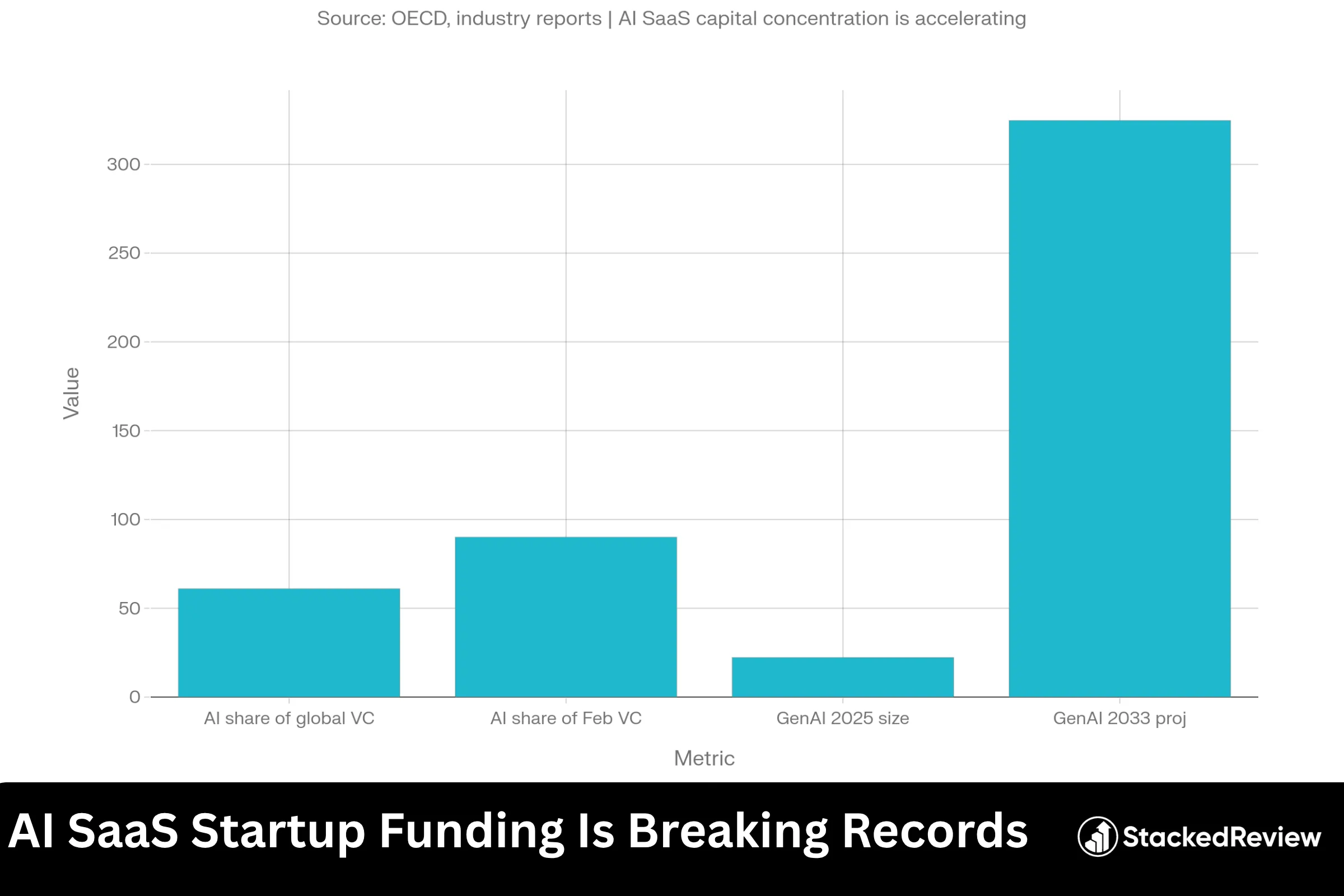
Venture capital is pouring into AI SaaS at unprecedented levels.
AI startups raised $214.5 billion in 2025, representing 79.3% of all global VC funding. In February 2026 alone, AI startups captured $171 billion, or 90% of all VC investment that month.
The OECD confirms AI now accounts for 61% ($258.7 billion) of all global VC investment. That is double the 30% share in 2022.
Key AI startup funding statistics for 2026:
At StackedReview, we are tracking several AI SaaS startups that went from seed to Series B in under 18 months. That pace was unheard of even two years ago.

What Comes Next for AI SaaS?
Growth will not slow down. Here is what major forecasts predict:
- By 2028, virtually 100% of enterprise SaaS applications will have AI-powered features
- AI-related software revenue is projected to grow 25–30% annually into the late 2020s
- 30% of traditional SaaS workflows will be replaced by AI-driven automation by 2027
- AI is expected to automate 30% of routine SaaS administration tasks by 2027
- Generative AI is expected to reduce SaaS noncompliance incidents by 30% by 2028
- 76% of leaders agree AI will automate specific tasks but not entirely replace roles
- AI SaaS market could reach $673 billion by 2030 and exceed $775 billion by 2031
- By 2032, broader SaaS market could surpass $1.23 trillion
The shift is from “AI as a feature” to “AI as a product.” SaaS companies that treat AI as a bolt-on will lose to those building AI-native experiences from day one.
For SaaS marketers planning 2026 and 2027 campaigns, the positioning should centre around autonomy, measurable ROI, and compliance-ready AI. Those three themes dominate buyer conversations right now.
Sources
- Statista – SaaS Market Forecast Worldwide
- Fortune Business Insights – AI SaaS Market Size and Forecast 2034
- The Business Research Company – AI SaaS Global Market Report
- Coherent Market Insights – AI Created SaaS Market 2026–2033
- Exploding Topics – Business Trends 2026
Affiliate Disclosure: This post may contain some affiliate links, which means we may receive a commission if you purchase something that we recommend at no additional cost for you (none whatsoever!)
Similar Posts






Verification process
Editorial standards
We’re a team of real users — not bots, not press-release copiers. Here’s exactly how we earn your trust on every single post.
We Actually Buy the Products
Every deal on this site is tested with a real purchase using our own accounts. We don’t rely on screenshots sent by vendors or press kits. If we say the discount works, we’ve clicked through checkout ourselves.
No Pay-to-Rank Policy
We never accept payment to feature or rank a deal higher. Affiliate commissions don’t influence our editorial scores — a bad deal stays ranked low regardless of commission size.
Monthly Re-Verification
Pricing changes fast. Our team re-tests every published deal at least once a month and immediately updates or removes any that have expired, changed, or been capped.
Expert Editorial Team
Our writers and editors have collectively spent 40,000+ hours hands-on with digital tools. We know what a fair price looks like — and we call out bad deals even when they’d earn us commissions.
Transparent Scoring Criteria
Every score is calculated from a public rubric: discount value, feature-to-price ratio, redemption ease, plan flexibility, and competitor comparison. No hidden weighting, ever.
Reader Feedback Loop
Thousands of readers report broken deals each month. Our team investigates every report within 24 hours and updates the page the same day a deal stops working.
Jaclyn Donaldson
Jaclyn is a content strategist at StackedReview with a passion for empowering small businesses. She specializes in dissecting social media advertising costs and hunting down the best-value deals. Her goal is to help brands stretch their budget further without compromising on results.