
SaaS Funding Statistics 2026: Rounds, Prices and Exit Data

By :
Jaclyn Donaldson
July 22, 2026


SaaS funding in 2026 splits into two markets: a few AI giants hoover up the cash, while everyone else fights over what is left. Global startup funding has already crossed $510 billion so far in 2026, and just two names, OpenAI and Anthropic, took about 43% of it.
SaaS still pulls the biggest slice of venture money of any sector, close to a third.
But the cheques are fewer, larger, and far pickier than before. Seed valuations sit at record highs. Public software multiples sit at decade lows.
Below are the SaaS funding statistics that matter this year, in plain numbers, no fluff.
SaaS Funding Statistics 2026: The Big Numbers First
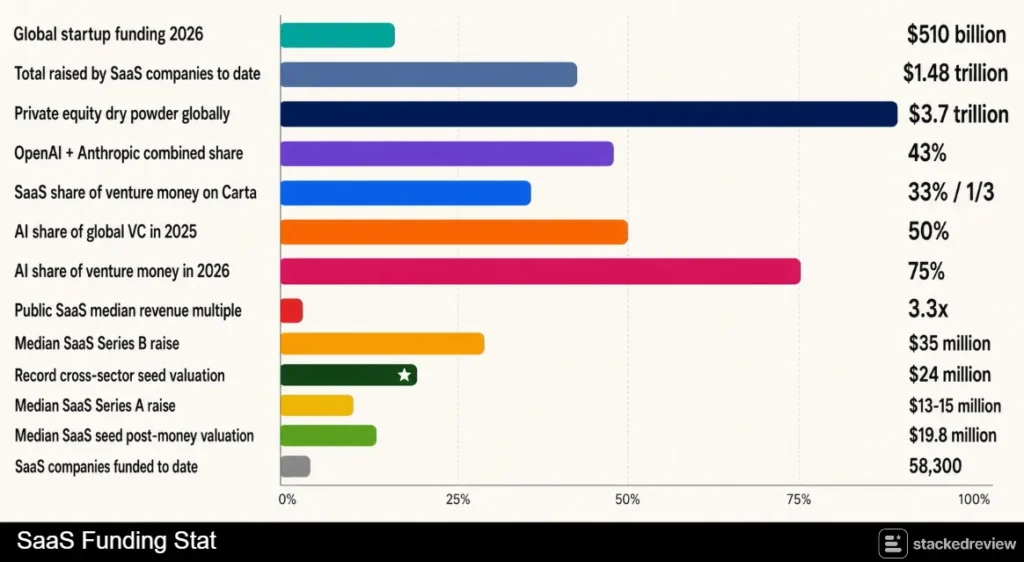
Let us start with the headline stats. No sleepy build-up. Just figures you can drop into a deck or a pitch today.
| SaaS funding metric | 2026 number to know |
|---|---|
| Global startup funding so far in 2026 | About $510 billion |
| Share taken by OpenAI and Anthropic alone | Roughly 43% of the total |
| SaaS share of all venture money on Carta | Around a third of every dollar |
| AI share of global venture capital in 2025 | Near half, by most counts |
| AI share of venture money in 2026 | Our read: about 75% |
| Median SaaS seed post-money valuation | $19.8 million |
| Record cross-sector seed valuation | $24 million, an all-time high |
| Median SaaS Series A raise | $13 to $15 million |
| Median SaaS Series B raise | About $35 million |
| Public SaaS median revenue multiple | 3.3x, the lowest on record |
| Private equity dry powder held globally | $3.7 trillion |
| SaaS companies funded to date | 58,300 firms, $1.48 trillion raised |
Those numbers tell one clear story. Money is still flowing into software. It is just moving with far more discipline than the free-for-all of 2021.
Our read: treat 2026 as a barbell year. Huge rounds at one end, a normal market at the other, and a thin, nervous middle.
Why 2026 Funding Feels Like Two Separate Markets
Founders keep asking us the same thing. Is funding back, or is it dead? The honest answer is both, at once.
At one end sit the frontier labs. They raise sums that would once have bought a small country. At the other end sit thousands of ordinary SaaS startups. They raise sensible rounds at sensible prices.
The gap between them has never been wider. A tiny group of deals now sets the headline, while the typical founder lives in a totally different reality.
Here is the split we watch most closely.
Strip out the giant AI rounds and the market looks calm and rational. Add them back in and it looks like a mania. Both pictures are true. You just need to know which one applies to your company.
The numbers make the divide obvious. A tiny handful of deals drives most of the dollar total. The count of ordinary rounds, though, looks steady and calm. So the average round size soars, while the median barely moves. Read the median if you want the truth about your own raise. The average belongs to the giants.
How AI Swallowed The Venture Cheque
You cannot read SaaS funding statistics in 2026 without talking about AI first. It stopped being one sector among many. It became the venture market itself.
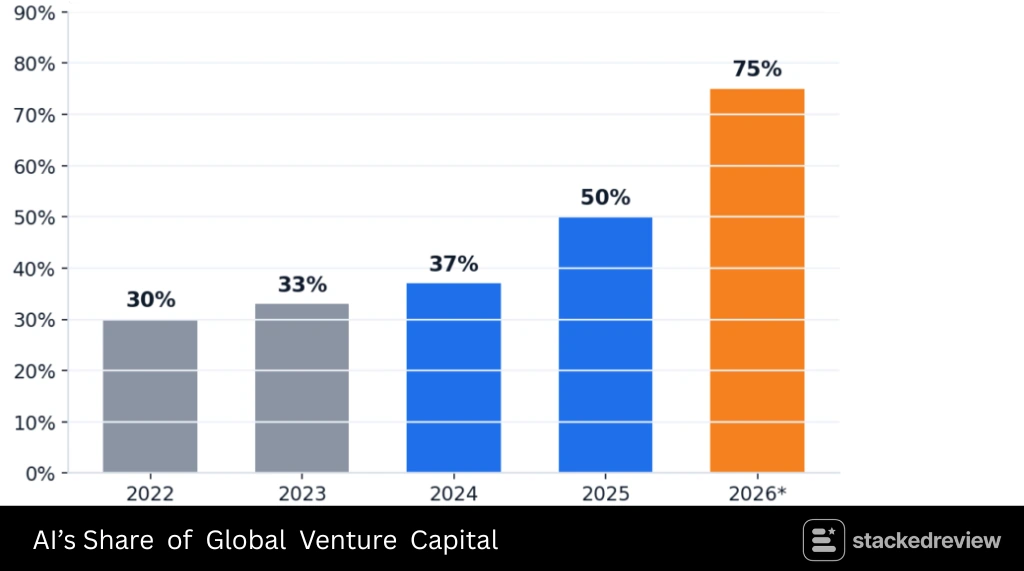
Look at the climb in AI startup funding share. In 2022, AI took roughly 30% of global venture capital. By 2025, most trackers put it near half. So far in 2026, the figure has jumped again toward three-quarters of every dollar.
The cash behind that share is staggering. AI startups pulled in about $114 billion in 2024. The following year that grew to roughly $202 billion, a 75% jump.
Then 2026 broke the model entirely. So far this year, AI has already pulled in more than $300 billion. The old rules of thumb no longer fit.
Two rounds explain a lot of the noise. Anthropic closed a $65 billion round in 2026 at a $965 billion valuation. That made it the most valuable private company on the planet, just ahead of OpenAI at $852 billion.
For a normal SaaS founder, this creates a strange problem. The headlines scream record money. Your inbox still says investors are picky. Both facts live side by side.
Straight talk: benchmark yourself against your own tier, not against a foundation model lab you will never compete with.
SaaS Still Grabs The Biggest Slice Of Venture Cash
Here is a fact that surprises people. Even with AI eating the headlines, plain software still wins the largest sector share of venture money.
Around a third of every dollar tracked on Carta went to SaaS companies. The next closest category, hardware, sat near 16%. So SaaS pulls roughly double the share of the runner-up.
That staying power matters. It means enterprise software funding has not collapsed. It has simply narrowed toward companies with real revenue and real retention.
The all-time picture backs this up. Across the market, 58,300 funded SaaS firms have raised about $1.48 trillion between them. That base has produced 693 unicorns and more than 2,800 public listings over the years.
The United States sits at the centre of it. American SaaS companies have attracted about $919 billion in total funding, far ahead of any other country.
Our read: SaaS is not out of favour. Weak SaaS is out of favour. Strong SaaS still gets funded fast.
SaaS Funding By Region: America Still Runs The Table
Location still shapes who gets funded. In 2026, one country sits far ahead of the rest.
The United States took about two-thirds of all global startup capital this year. The share slipped from an even higher mark earlier on. Yet it still dwarfs every rival.
American SaaS firms have raised about $919 billion in total funding over the years. No other market comes close on enterprise software funding at that scale.
The United Kingdom leads the chasing pack by company count. It hosts around 1,700 SaaS firms, the second-largest base after America.
Other hubs punch below their weight on cheque size. Founders in Europe and Asia tend to raise smaller rounds and burn less cash per stage.
Our read: if you build outside America, plan for tighter rounds and a longer path. Capital efficiency becomes your best weapon, not your backup.
Seed Stage Money In 2026: Record Prices, Higher Bars
Seed is where the mood shift shows up first. Prices are up. Standards are up even more.
The median SaaS seed post-money valuation now sits at $19.8 million. Across all sectors, the median hit $24 million, the highest seed figure ever recorded.
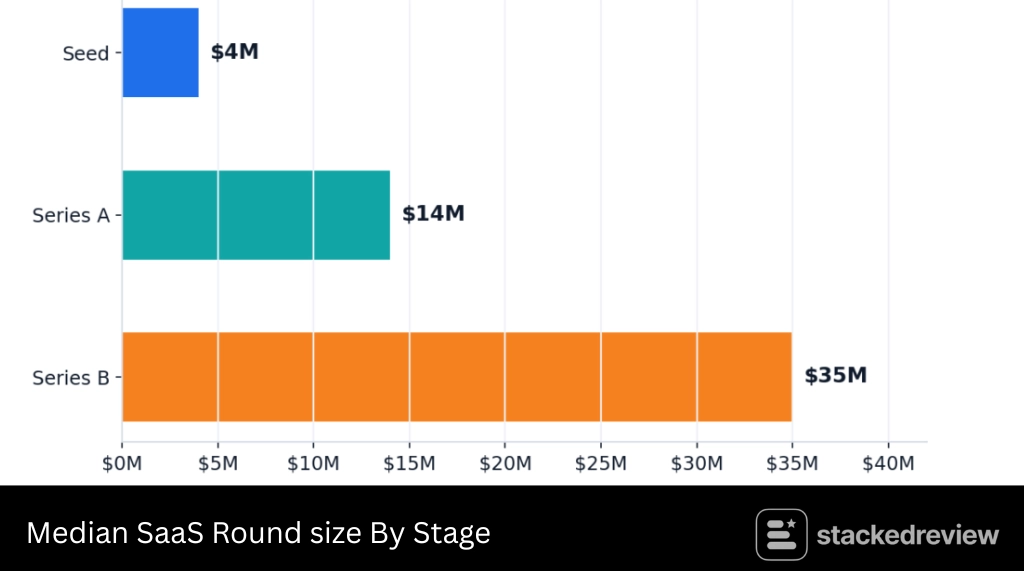
Round sizes have grown too. A typical SaaS seed lands near $4 million, with founders giving up about 19% to 20% of the company. Over 90% of these rounds still run on simple SAFEs for speed.
But the AI split runs right through seed as well. Carta now sorts SaaS into AI and non-AI buckets because the prices differ so much.
| Seed metric (2026) | Non-AI SaaS | AI-native SaaS |
|---|---|---|
| Median valuation | About $15 million | About $19 million |
| Median round size | About $3.1 million | About $4.6 million |
| Typical dilution | 18% to 20% | 18% to 20% |
| Investor bar | Real traction | Model plus traction |
| Premium over peers | Baseline | 30% to 40% higher |
The gap gets wild at the top. Frontier AI infrastructure startups have raised seed stage valuations of $160 million to $200 million. Those deals warp the averages for everyone below them.
For most founders, the real story is the rising bar. Seed today asks for what Series A once did. Investors want $300,000 to $500,000 in early recurring revenue before they lean in.
What we would tell a seed founder: the barbell rules here too. Tiny pre-seed rounds and hot large ones close easily. The plain middle round is the hard one.
Series A Got Harder And A Lot More Expensive
Series A is where the post-2022 reset shows most clearly. The maths changed, and it changed against founders without AI stories.
The median SaaS Series A raise now sits between $13 million and $15 million. A few years ago it was closer to $8 million to $10 million. So round sizes rose by roughly half.
Valuations moved with them. Most Series A rounds land between $25 million and $50 million. In the Bay Area, average post-money figures push near $85 million.
The revenue bar is the brutal part. What earned a Series A in 2019, about $1 million in recurring revenue, does not come close now. The floor tripled to near $3.5 million in annual recurring revenue.
Here is how the Series A funding round shapes up by profile.
| Series A profile (2026) | Recurring revenue | Growth rate | Likely outcome |
|---|---|---|---|
| AI-native leader | $2M to $4M | 150%+ | Competitive, premium priced |
| Strong non-AI SaaS | $3M to $5M | 120%+ | Fundable at fair terms |
| Average SaaS | $1M to $2M | 80% to 100% | Slow, single-offer path |
| Slow grower | Under $1M | Below 80% | Very hard conversation |
The AI startup funding share premium shows here as well. An AI Series A can price at nearly double the overall median. At the extreme, an AI foundation-model round has been priced near $300 million while a non-AI peer sat near $55 million.
The catch is that investors now test the word “AI” hard. A slide title does not earn the premium. Measurable gains in retention or cost do.
Series B And The Great SaaS Repricing
Series B is where old, inflated valuations come home to roost. The pain here is simple arithmetic, not failure.
Total Series B capital fell sharply in 2025, down about 26% against the year before. Fewer rounds closed. The ones that did close were big.
The median Series B now sits near $35 million, on a post-money valuation of roughly $130 million to $150 million. To reach it cleanly, most firms need $5 million to $10 million in recurring revenue.
Revenue multiples tell the real story. In 2021, SaaS firms could command 20x to 30x recurring revenue at this stage. Now the range clusters at 8x to 12x for strong companies.
At Series B, the story stops carrying the round. Unit economics, retention, and gross margin carry it instead. The numbers do the talking now.
Our honest take: if you raised a $100 million round in 2022 and grew slowly since, plan for a reset. It stings, but a clean down round beats no round.
The Rule Of 40 Now Decides Who Gets Funded
One number keeps coming up in 2026 pitch meetings. Investors want to see the Rule of 40.
The idea is simple. Add your growth rate to your profit margin. A total above 40 signals a healthy, fundable business.
The old game was growth at any cost. Those days are gone. Burn without payback now worries investors more than slow growth does.
Quality metrics set the price. Strong net revenue retention above 110% and healthy gross margins move a company to the front of the queue.
The reward is real money. A SaaS firm with a Rule of 40 score above 50, plus retention above 110%, can fetch 6x to 8x recurring revenue on a sale. The median firm fetches closer to 4.5x.
Here is what buyers and backers weigh most in 2026:
Straight talk: you can no longer buy growth and hope. The numbers behind the growth now decide the cheque.
Public SaaS Multiples Took A Serious Beating
Private prices always follow public ones. So the pain in listed software matters to every founder, not just public ones.
The median public SaaS revenue multiple fell to 3.3x in early 2026. That marks the lowest reading since tracking began more than a decade ago.
The slide has been steep and steady. Public SaaS revenue multiples sat near 6.2x at the end of 2024, then 4.9x at the end of 2025, then 3.3x soon after. Private firms track a little higher, near 4.5x recurring revenue.
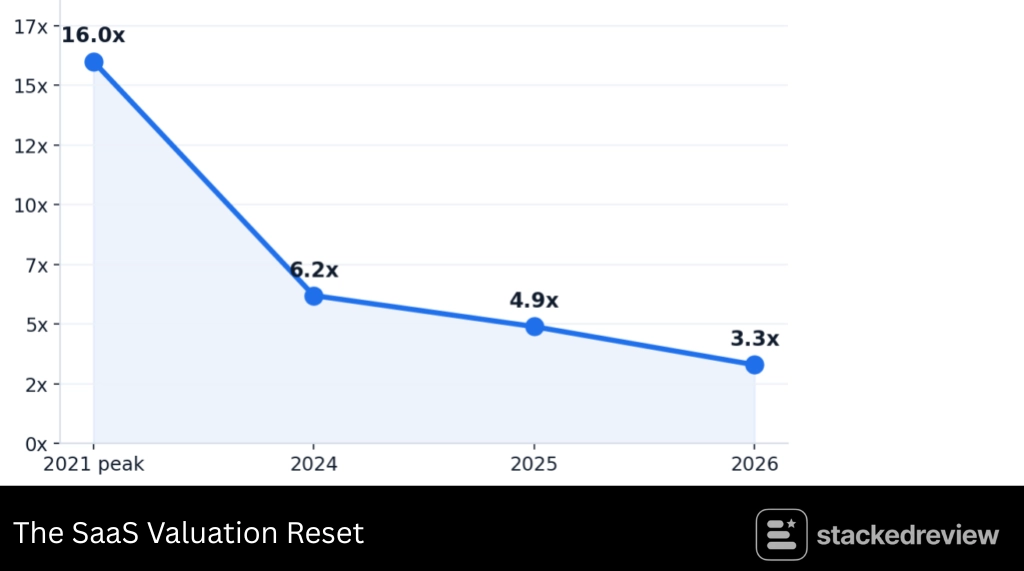
Part of the drop is fear about AI agents. Investors worry that smart software could automate the very workflows many SaaS tools sell. Some big names lost a large chunk of their value on that worry alone.
The knock-on effect is real. When public prices fall, private buyers reset their offers too. Mid-stage SaaS founders feel the squeeze most.
The Exit Doors: IPO Versus M&A In 2026
Founders ask us which exit door is open. In 2026, the answer is clear. Most of them walk through the sale door, not the listing door.
The public market technically reopened. In 2025, United States issuers completed 202 listings and raised about $44 billion, the strongest year since 2021.
But software stayed away. No venture-backed SaaS unicorn filed to go public in the opening stretch of 2026. One notable software listing, Liftoff Mobile, filed a $711 million deal and then pulled it weeks later.
So sales won by a mile. Across 2025, buyers acquired 995 venture-backed United States companies, against just 62 public listings. That means about 94% of all exits were trade sales.
| Exit path (2025 to 2026) | What the data shows |
|---|---|
| SaaS unicorn listings filed | Effectively zero in early 2026 |
| Venture-backed acquisitions | 995 deals, about $112 billion |
| Venture-backed listings | 62 deals, about $119 billion |
| Share of exits that were sales | About 94% |
| SaaS share of software M&A | Around 58% |
| SaaS M&A deals in 2025 | Near 2,700, a record high |
The SaaS mergers and acquisitions market is where the real action lives. In 2025, SaaS made up roughly 58% of all software deals, and total activity hit a record.
AI shaped those deals too. About 72% of SaaS takeover targets waved an AI flag in their positioning. Buyers wanted training data and embedded models, not just revenue.
Big cheques prove the point. Thoma Bravo closed about $42 billion of buyouts in 2025, including a $12.3 billion take-private of Dayforce. Vista and Blackstone paid $8.4 billion for Smartsheet.
Horizontal Versus Vertical SaaS Funding
Not all SaaS raises the same way. The split between broad tools and industry-specific tools tells its own story.
Horizontal SaaS funding rose on the back of bigger rounds, not more deals. Deal count moved from 32 in 2024 to 35 in 2025, while capital climbed from about $1.70 billion to $2.33 billion.
Round sizes stretched fast. The average horizontal round grew from $53 million in 2024 to $67 million in 2025, then near $86 million in 2026. The median held steady at $35 million.
That gap between average and median matters. A steady median says the typical round is normal. A rising average says a few whales are pulling the headline up.
Vertical SaaS funding cooled at the top but held in the middle. Across a recent 12-month window, 32 vertical deals raised about $988 million.
| SaaS type | 2025 capital | 2026 direction | What we notice |
|---|---|---|---|
| Horizontal SaaS | $2.33 billion | Bigger rounds, flat deal count | Money chasing clear winners |
| Vertical SaaS | Near $2.7 billion | Fewer mega-rounds, steady base | Broad money, missing giants |
| Horizontal trend | 12-month view | Down about 35% | Headline capital pulled back |
| Vertical trend | 12-month view | Roughly flat, up 3% | Steadier than broad tools |
Strip out the giant rounds and vertical SaaS actually looks healthier in 2026. The everyday financing layer grew, even as the headline mega-round layer shrank.
Repeat investors cluster around AI-native legal, financial, construction, and healthcare tools. That is where conviction sits right now.
Private Equity Is Sitting On A Mountain Of Cash
Behind every SaaS exit stat sits one huge force. Private equity has more spare cash than at almost any point in history.
Firms entered 2026 holding about $3.7 trillion in global private equity dry powder. That is roughly double what they held back in 2019.
In the United States alone, close to $1 trillion is earmarked for deals. Fund managers face real pressure to spend it before deadlines pass.
Software is where much of that money lands. Software made up about 65% of all tech deal value in 2025, and SaaS made up the bulk of that.
The median private SaaS firm in the lower middle market trades near 4.5x recurring revenue. But quality changes everything. Companies with strong growth, high retention, and a Rule of 40 score above 50 can still fetch 6x to 8x.
What we would bet on: a busy sale market through 2026, as this cash pile meets a wave of 2021-vintage companies looking for a home.
Down Rounds And Bridges: The Quiet Side Of 2026
Not every 2026 round is a victory lap. Plenty of firms raise quietly, at lower prices, just to keep the lights on.
The 2021 vintage feels the most heat. Many priced high back then and grew slowly since. For them, a flat or lower round is plain maths, not shame.
Bridge rounds have become normal. More founders now raise a small top-up, often called a seed-plus round, before they hit true Series A metrics.
The gap between stages stretched too. The typical wait from seed to Series A grew longer, so runway planning got harder.
We keep telling founders the same thing. A clean down round beats a proud zero. Survival buys the chance to raise again on better terms later.
Our take: cash discipline is the real flex in 2026. The founders who trimmed early are the ones still standing today.
StackedReview 2026 SaaS Funding Projections
We have watched this market for years, so here is where we put our own numbers. Treat these as StackedReview working figures, not official totals. They are built from current data and our read of the year.
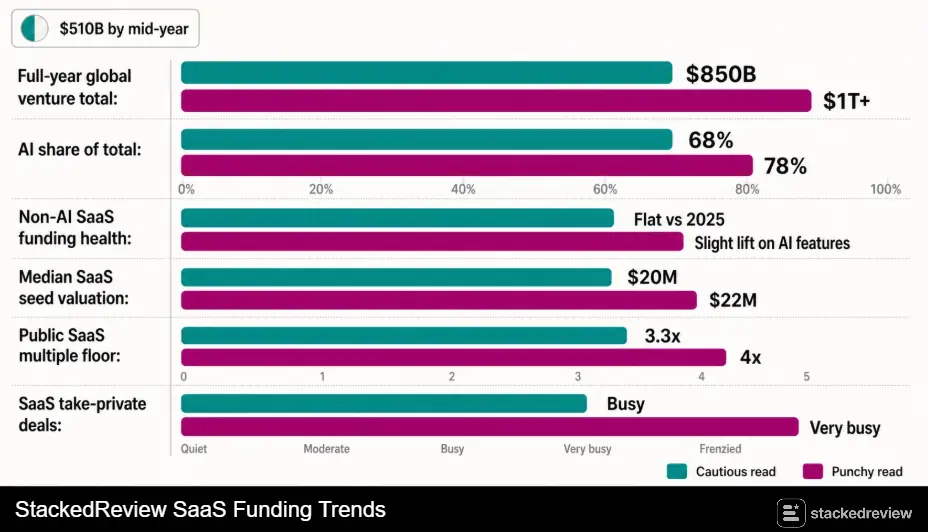
Global funding is on a record pace. More than $510 billion landed by mid-year. So we expect the full 2026 total to push well past $900 billion, if the venture capital mega rounds hold.
But that headline hides a plainer truth. Take out the frontier labs, and the “normal” venture market sits near historical averages, not a boom.
| StackedReview 2026 projection | Cautious read | Punchy read |
|---|---|---|
| Full-year global venture total | $850 billion | $1 trillion plus |
| AI share of the total | 68% | 78% |
| Non-AI SaaS funding health | Flat vs 2025 | Slight lift on AI features |
| Median SaaS seed valuation | Holds near $20M | Drifts toward $22M |
| Public SaaS multiple floor | Steady near 3.3x | Small bounce to 4x |
| SaaS take-private deals | Busy | Very busy |
Here is the pattern we keep seeing. The application layer has not died. It has narrowed to firms that own their data, their workflow, or their distribution.
If a frontier model can copy your product in a weekend, funding gets hard. If your moat is real data and sticky users, funding stays open.
That is the sharpest lesson inside these SaaS funding statistics for 2026. Defensibility now decides the cheque.
What These SaaS Funding Statistics Mean For Founders
Numbers are only useful if they change what you do. So here is the plain playbook we draw from the 2026 data.
The mood in 2026 rewards discipline. Fewer vanity metrics. More proof of durable revenue.
For marketers and operators inside SaaS, the read is similar. Budgets favour tools that show clear payback, not tools that simply sound modern.
Our closing take: this is a builder’s market for anyone with real numbers. It is a painful one for anyone still living on a 2021 story.
One more thing worth saying out loud. The bar will not drop back soon. Investors have learned to wait, and their cash pile gives them the patience to do it. So the winners in 2026 share a habit. They raise less, spend slowly, and let strong numbers pull the next round toward them. That quiet edge sits behind almost every funded SaaS story this year.
How We Read The 2026 SaaS Funding Data
A quick word on method, since trust matters here. We do not copy one press release and call it a trend.
We cross-check every headline figure against several trackers. Where sources clash, we say so. Then we give our own blended read instead of a false single truth.
We also split the giant AI rounds from the everyday market. A single $65 billion deal can bend an average until it means nothing. So we watch medians, not just averages.
Our projections carry the StackedReview label on purpose. They are informed calls, built from years of watching software raise, spend, and exit. They are not gospel, and we mark them clearly.
That is how we keep these funding numbers honest. Real figures where they exist, clear estimates where they do not, and no hype dressed up as fact.
Frequently Asked Questions About SaaS Funding In 2026
How much SaaS funding happened in 2026?
Global startup funding crossed about $510 billion by mid-2026. SaaS took roughly a third of all venture money on Carta, the largest share of any sector.
What is the median SaaS seed valuation in 2026?
The median SaaS seed post-money valuation sits at $19.8 million. Across all sectors, the seed median hit a record $24 million.
How big is a SaaS Series A in 2026?
A typical SaaS Series A raises $13 million to $15 million. Valuations usually land between $25 million and $50 million, with higher figures in the Bay Area.
Why are public SaaS valuations so low?
The median public SaaS revenue multiple fell to 3.3x, a record low. Fears about AI agents automating software workflows drove much of the drop.
Is it easier to sell a SaaS company or take it public?
Selling is far more common. About 94% of venture-backed exits were trade sales, and no SaaS unicorn filed to go public early in 2026.
How much money is chasing SaaS deals?
Private equity holds about $3.7 trillion in global dry powder. Software attracts most of that spend, which keeps the sale market busy.
Sources Used
- Crunchbase venture and exit data 2025 to 2026
- Carta State of Private Markets
- OECD data on AI venture capital share
- CB Insights State of Venture
- Software Equity Group 2026 Annual SaaS Report
- Aventis Advisors SaaS valuation multiples
- PitchBook and NVCA Venture Monitor
- Renaissance Capital IPO data
- Tracxn SaaS sector data
- Statista SaaS market outlook

Affiliate Disclosure: This post may contain some affiliate links, which means we may receive a commission if you purchase something that we recommend at no additional cost for you (none whatsoever!)
Similar Posts




Verification process
Editorial standards
We’re a team of real users — not bots, not press-release copiers. Here’s exactly how we earn your trust on every single post.
We Actually Buy the Products
Every deal on this site is tested with a real purchase using our own accounts. We don’t rely on screenshots sent by vendors or press kits. If we say the discount works, we’ve clicked through checkout ourselves.
No Pay-to-Rank Policy
We never accept payment to feature or rank a deal higher. Affiliate commissions don’t influence our editorial scores — a bad deal stays ranked low regardless of commission size.
Monthly Re-Verification
Pricing changes fast. Our team re-tests every published deal at least once a month and immediately updates or removes any that have expired, changed, or been capped.
Expert Editorial Team
Our writers and editors have collectively spent 40,000+ hours hands-on with digital tools. We know what a fair price looks like — and we call out bad deals even when they’d earn us commissions.
Transparent Scoring Criteria
Every score is calculated from a public rubric: discount value, feature-to-price ratio, redemption ease, plan flexibility, and competitor comparison. No hidden weighting, ever.
Reader Feedback Loop
Thousands of readers report broken deals each month. Our team investigates every report within 24 hours and updates the page the same day a deal stops working.
Jaclyn Donaldson
Jaclyn is a content strategist at StackedReview with a passion for empowering small businesses. She specializes in dissecting social media advertising costs and hunting down the best-value deals. Her goal is to help brands stretch their budget further without compromising on results.