Creator Economy Statistics: Market Size and Income in 2026

By :
Jaclyn Donaldson
August 4, 2026
Here is the headline we keep coming back to. The global creator economy market size sits near $250 billion in 2026. Yet more than half of creators still earn under $15,000 a year. Big at the top. Brutal at the bottom. That gap is the whole story.
We run StackedReview. We test tools, track spend, and read the boring reports so you do not have to. This piece pulls the Creator Economy Statistics that actually move budgets in 2026, not vanity numbers. Expect market size, creator income tiers, platform payouts, brand spend, AI adoption, and our own calls on where the money goes next.
Straight talk from our desk: The creator economy is not one market. It is a small professional class stacked on top of a giant hobbyist base. Read every stat below with that split in mind, and the numbers stop lying to you.
How Big Is the Creator Economy Market Size in 2026?
Ask ten analysts, get ten numbers. The reason is simple. Some count only creator earnings. Others fold in tools, commerce, subscriptions, and platform revenue.
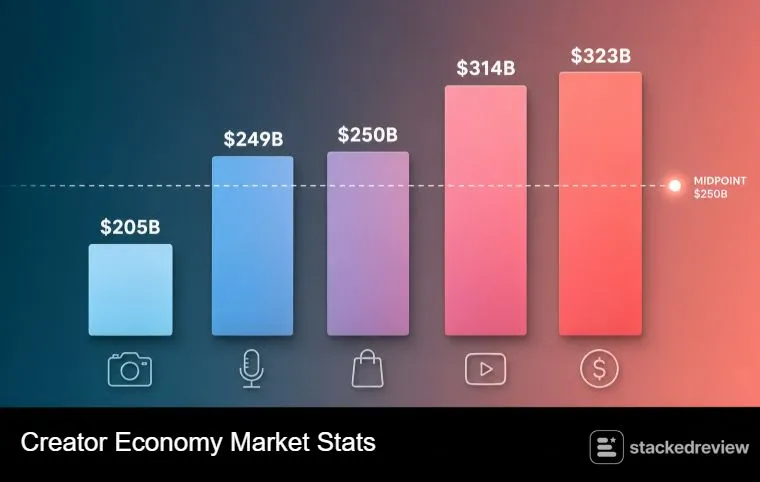
So the 2026 valuations range widely. The low end sits near $205 billion. The high end pushes past $323 billion.
Our working figure is around $250 billion for the core content-monetisation market. We landed there after weighing the mid-range reports against actual brand spend flowing into creator deals.
Why do we trust the middle over the extremes? The lowest numbers count only creator earnings and miss the tools and commerce around them. The highest numbers count everything, including revenue creators never touch.
The truth sits between. A quarter-trillion-dollar market is still enormous. It is bigger than plenty of national economies, and it barely existed fifteen years ago.
Here is how the main 2026 estimates stack up.
| Source Type | 2026 Market Size | What It Counts | Growth Rate |
|---|---|---|---|
| Broad market estimate | $323.48 billion | Earnings, tools, commerce, platforms | about 23% CAGR |
| Mid-range estimate | $314 billion | Earnings plus adjacent services | 21.8% CAGR |
| Our StackedReview figure | about $250 billion | Core creator monetisation only | about 22% CAGR |
| Demand-side estimate | $248.95 billion | Content monetisation plus deals | 22.9% CAGR |
| Conservative estimate | $205.25 billion | Direct creator earnings, 2024 base | about 22% CAGR |
Notice the pattern. Wider definitions produce bigger numbers. Nothing shady about it. You just need to know which market a report is measuring before you quote it in a pitch deck.
Our read on this: When a founder tells us the market is “half a trillion dollars”, we ask which year and which definition. Nine times out of ten the number is a 2027 or 2030 projection quoted as if it were today. Use the $250 billion core figure for 2026. Save the trillion-dollar talk for the forecast slide.
Creator Economy Growth Forecast: Where the Numbers Head Next
Now the fun part. The forecasts.
Goldman Sachs put the market near $480 billion by 2027. Longer term, several firms see the number crossing $1 trillion by the early 2030s.
We treat these as directional, not gospel. Still, the direction is clear. Steady 20% plus annual growth for years.
Below is the creator economy growth forecast we work from, blending the mainstream projections with our own read.
| Year | Projected Market Size | Annual Growth | What Drives It |
|---|---|---|---|
| 2024 | $205 billion | Base year | Brand deals, platform payouts |
| 2025 | $252 billion | about 22% | Short-form video, ad recovery |
| 2026 | about $250 to $323 billion | about 22% | AI tooling, social commerce |
| 2027 | $480 billion (broad) | about 24% | Commerce plus creator brands |
| 2030 | $528 billion | about 22% | Owned audiences, subscriptions |
| 2033 to 2034 | $1.05 to $1.35 trillion | about 22% | Full mainstream ad shift |
Here is a simple view of the climb from 2020 to 2030.
How Many Creators Are There Worldwide Right Now?
Roughly 207 million people call themselves creators in 2026. That number gets thrown around a lot, so let us break it down properly.
Most of those 207 million are casual. They post, they build small audiences, they rarely earn much.
The professional tier is far smaller. Around 50 million count as semi-professional or professional. Only about 2 million earn a full-time living.
The United States alone claims 162 million people who identify as creators. More than 45 million of them treat it as a profession.
So the creator base is huge and bottom-heavy. Two-thirds are nano accounts. The pyramid is wide at the base and thin at the peak.
The bit brands miss: Everyone chases the 2 million full-timers. Smart brands we work with fish in the nano and micro pool instead. Cheaper partnerships, tighter niches, and engagement rates the mega-accounts cannot touch.
Creator Income Reality: Who Actually Earns What
Time for the number that keeps creators up at night. More than half earn under $15,000 a year.
That figure rose from 48% in 2023. So the bottom is getting more crowded, not less.
At the top, only about 4% clear $100,000 a year. The gap between those two groups is enormous.
Average earnings play tricks on you here. The mean sits near $11,400. The median is closer to $3,000.
When mean and median split that hard, you know a thin top tier is dragging the average up. One CreatorIQ survey pool averaged $44,293, yet only 11% actually reported six-figure income.
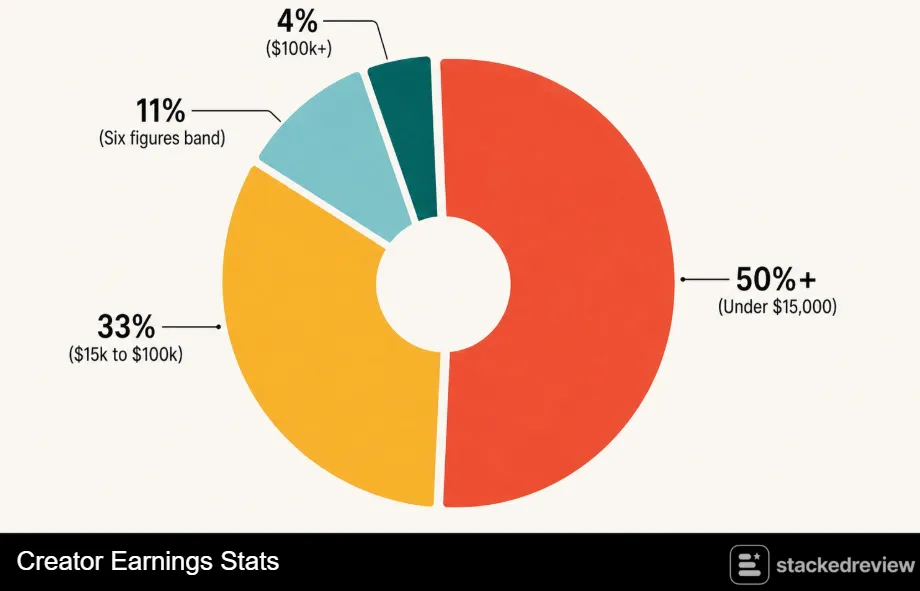
Here is the income picture by tier for 2026.
| Creator Tier | Annual Income | Share of Creators | Reality Check |
|---|---|---|---|
| Hobbyist base | Under $15,000 | More than 50% | Side-hustle money, not a salary |
| Emerging middle | $15,000 to $50,000 | Around 33% | Growing, still below a living wage |
| Creator middle class | $10,000 to $100,000 | about 45.6% combined band | The real growth story of 2026 |
| Professional class | $100,000 plus | About 4% | Full-time, business-minded operators |
| Established full-timers | $133,000 median | Small elite | Treat content as a media company |
One bright spot. The creator middle class is real now. Nearly 46% of committed creators sit in the $10,000 to $100,000 band.
And momentum is building. Around 51.5% of US creators saw their earnings grow year over year in 2025.
Here is the split that matters most, drawn out.
Creator Income Distribution 2026Under $15,000: 50%+$15k to $100k: about 33%Six figures: about 11%$100k+: about 4%
Two more numbers worth your time. About 57% of full-time creators earn below the US living wage of $44,000.
And the pay gap runs deep. Male creators average close to $69,900, while female creators average near $37,000, despite women making up most of the creator base.
Where we would put our energy: Going full-time is not the finish line people sell it as. We have watched committed part-timers with one strong income stream out-earn stressed full-timers spread across five weak ones. Pick one channel. Get paid well on it. Then add the next.
Creator Revenue Streams: Following the Money in 2026
So where does creator income actually come from? Brand deals still lead by a mile.
Around 70% of total creator revenue traces back to brand partnerships. Nearly 69% of creators name brand deals as their main income source.
But the mix is shifting. Only 49% now earn primarily from brand deals, down ten points from 2023.
That drop is healthy. It means creators are spreading their income across more sources.
Think of it as the difference between one paycheque and a portfolio. A creator leaning on a single brand deal is one lost contract away from zero. A creator with deals, memberships, and affiliate income has a cushion.
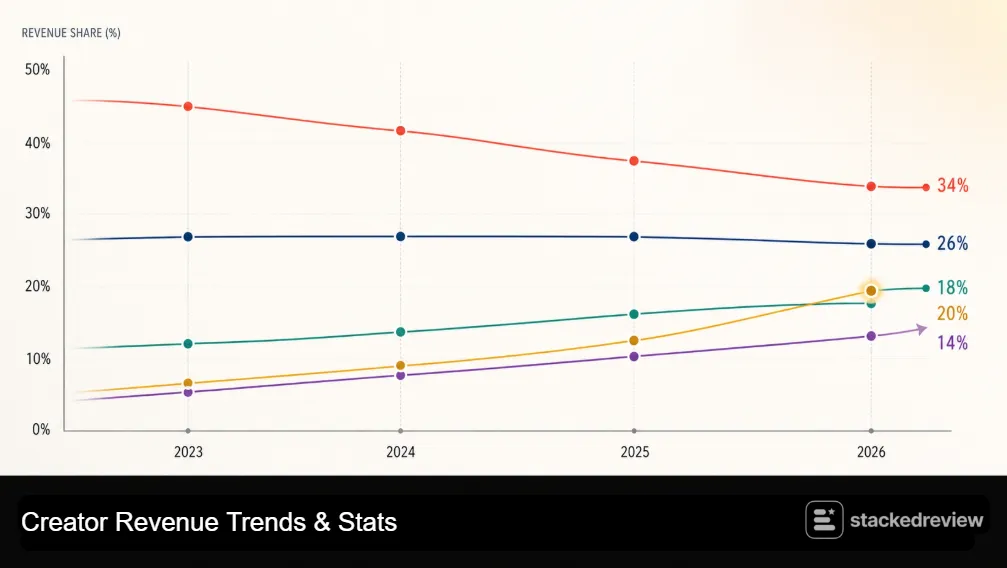
Here is the 2026 revenue split we track.
| Revenue Stream | Share of Creator Income | Who It Works Best For |
|---|---|---|
| Sponsored content and brand deals | about 59% | Mid-tier and pro creators |
| Platform payouts and ad share | about 24.4% | High-view video creators |
| Affiliate marketing income | about 8.2% | Review and tutorial niches |
| Subscriptions and memberships | Growing fast | Community-led creators |
| Digital products and courses | Rising steadily | Expert and educator creators |
Now the single most useful stat we found on earnings. Diversification pays, and the maths is blunt.
Among full-time creators earning at least $60,000, those with three or more income streams earn about $75,000 more on average. Top earners run seven or more streams. Low earners run two.
What we would do with this: If you advise creators or run a brand programme, stop treating brand deals as the finish line. The creators worth partnering with in 2026 already run merch, memberships, and affiliate income. They think like businesses. Partner with the ones building an asset, not the ones renting reach.
The Creator Burnout Problem Nobody Puts on the Slide
Here is a stat the growth charts skip. When half of all creators earn under $15,000, the burnout is not a mood. It is an economic outcome.
Nearly 70% of creators report some form of financial insecurity. Chasing the algorithm while barely covering costs wears people down fast.
The churn shows up in the numbers. Plenty of creators quit within a year or two of starting.
Why does this matter to a brand? Because the creator you sign today might vanish tomorrow. Partner stability is a real risk in this market.
The lesson runs both ways. Creators who build owned audiences, such as email lists and communities, survive the algorithm swings. The ones who rent every ounce of reach from a single platform live on borrowed time.
What this means for your programme: Sign creators who own their audience, not just their follower count. A creator with a 20,000-person email list is a safer bet than one with a million followers and no direct line to them. Ownership beats reach when the algorithm turns.
Platform Payouts Compared: YouTube, TikTok, and Instagram
Not all platforms pay the same. Far from it. Where a creator posts shapes how much they keep.
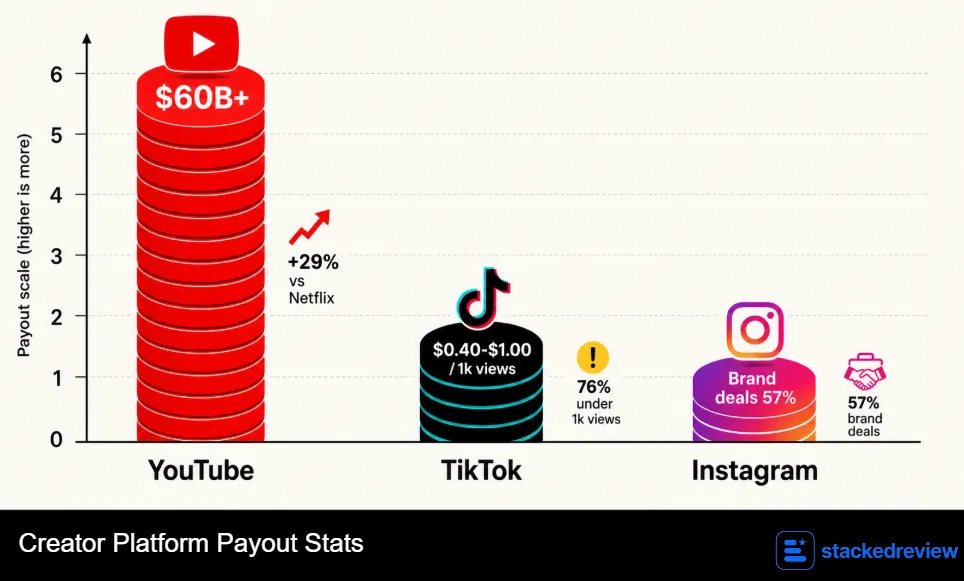
YouTube remains the payout king. It generated over $60 billion in revenue in 2025 and beat Netflix by roughly a third.
More impressive to us: YouTube has paid creators, artists, and media partners over $100 billion since 2021. Its 55% ad revenue share is still the most generous on the board.
TikTok drives reach but pays thinner. Its Creator Rewards Programme pays between $0.40 and $1.00 per 1,000 views, far above the old fund.
Instagram wins on brand deals rather than direct payouts. It leads brand partnership adoption at 57%.
Here is how the big three compare in 2026.
| Platform | Scale | How Creators Get Paid | Best For |
|---|---|---|---|
| YouTube | 2.7 billion monthly users, 2M+ in Partner Programme | 55% ad share, $2 to $25 per 1,000 views | Long-term direct revenue |
| TikTok | 1.6 billion+ users worldwide | $0.40 to $1.00 per 1,000 views, 90% sub share (US) | Fast reach and audience growth |
| 200M+ creator and business accounts | Bonuses, subscriptions, brand deals | Brand partnership revenue |
One sobering TikTok stat. About 76% of TikTok creator posts get fewer than 1,000 views.
So the viral dream is rare. The platform is a reach machine for a few and a quiet room for most.
Video still owns the money. Video streaming platforms claimed 39% of total creator economy revenue, the single largest slice.
Our platform call: For direct, bankable income, YouTube still beats everything. For reach and top-of-funnel visibility, TikTok earns its keep. Instagram sits in between as the brand-deal engine. Most serious creators we track run all three and repurpose one piece of content across them.
Brand Spend on Creators: The Money Flowing In
Now the number brands care about most. Global influencer marketing spend hit $32.55 billion in 2025.
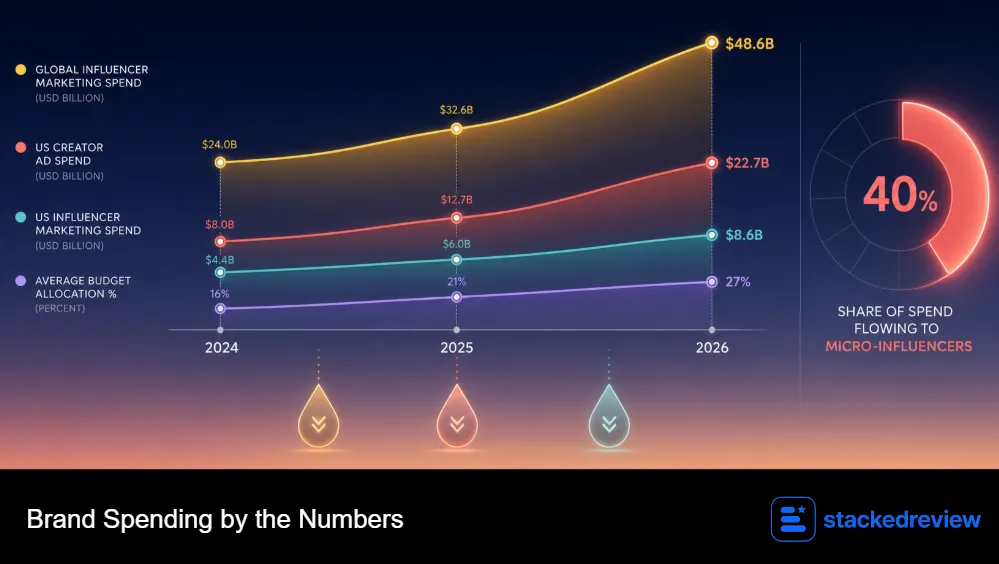
That is a 35.6% jump from $24 billion in 2024. Fast growth by any measure.
For 2026, the projections cluster between $34 billion and $40.5 billion. US influencer spend alone lands near $12.7 billion.
Adoption tells the same story. Around 86% of large US marketers used influencer marketing in 2025, up from about 70% in 2021.
Here is the brand-side spending picture.
| Metric | 2024 | 2025 | 2026 Outlook |
|---|---|---|---|
| Global influencer marketing spend | $24 billion | $32.55 billion | $34 to $40.5 billion |
| US influencer marketing spend | about $9.3 billion | about $11.6 billion | about $12.7 billion |
| US creator ad spend | about $29 billion | $37 billion | about $43.9 billion |
| Marketers using influencer marketing | about 80% | 86% | 87% plus |
| Average budget allocation | 18% | about 21% | 23% of marketing spend |
The commitment is deepening. About 74% of brands are moving budgets into creator programmes as a core strategy in 2026.
And nearly 12% of brands now spend more than half their entire marketing budget on creators. That would have sounded mad five years ago.
The shift is structural, not a passing fad. Creator budgets used to be a small test line. Now they sit at the centre of the media plan.
Micro-influencers pull a large share of that money. Around 40% of creator funds go straight to smaller accounts with tighter niches.
The reason is plain. Micro and nano creators post higher engagement per dollar than the mega-accounts, and they cost a fraction as much.
Return on Creator Spend: Does the Maths Work?
Brands are not spending out of hope. The returns hold up.
On average, brands earn $5.78 for every $1 spent on influencer marketing. That is up from $5.20 in 2023.
Top campaigns do far better, returning between $11 and $18 per dollar. Those are numbers most ad channels cannot match.
Consumer behaviour backs it up. Around 86% of consumers say they made a purchase driven by a creator in the past year.
Social commerce adds fuel. Global social commerce sales reached $992 billion in 2025, and live shopping converts at about 30% against 2% to 3% for standard e-commerce.
The honest caveat: That $5.78 average hides wild variance. We have seen creator campaigns return double digits and others sink without trace. Measurement is still the weak link. Around 79% of marketers name proving ROI as their biggest headache. If you cannot track it cleanly, that headline number means little.
AI in the Creator Economy: Tool of the Year
You cannot talk 2026 creator data without AI. Adoption went vertical.
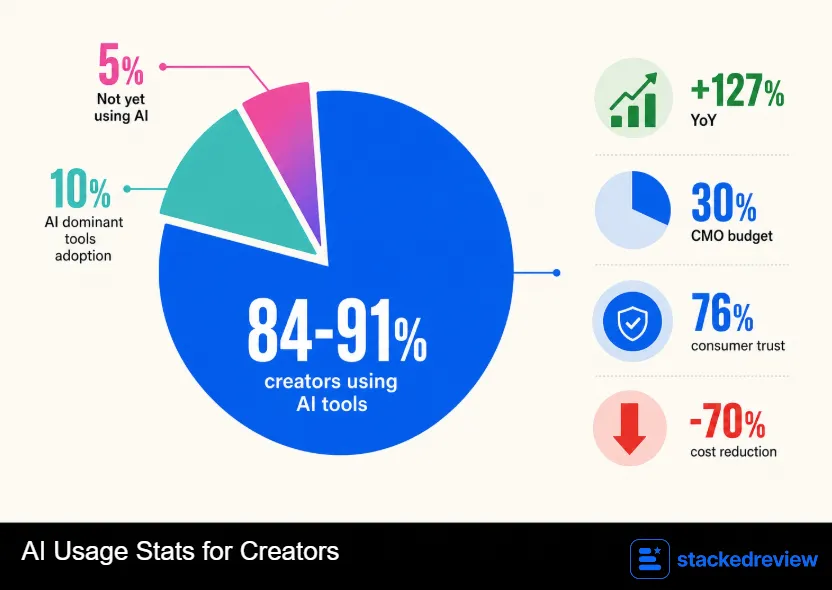
Somewhere between 84% and 91% of creators now use generative AI tools in their workflow. Scripts, thumbnails, editing, ideation, all of it.
The edge is measurable. Top earners use AI roughly twice as often and report far stronger engagement.
Cost is the obvious driver. AI-assisted content can cost around 70% less to produce than traditional methods.
Not everyone is thrilled. About 61% of human creators worry about rising competition from AI-generated rivals.
Virtual creators are a real category now, not a gimmick. Some CMOs plan to route a chunk of budget toward AI-built personalities.
Still, the trust picture is split. Consumers say they trust virtual creators for product tips, yet human creators keep the edge on genuine connection.
We watch one metric above the rest here. Engagement per piece of content. AI helps creators publish more, but more content only pays if the audience still cares. Volume without connection is just noise.
Our take on the AI panic: AI is a co-pilot, not a replacement. The creators pulling ahead use it to move faster on the boring parts, then spend the saved time on the thing AI cannot fake: lived experience and a real community. Speed is cheap now. Trust is not.
Who Creators Actually Are: Demographics That Matter
Let us put faces to the numbers. The creator base skews young, and it skews female.
Women make up between 64% and 77% of earning creators, depending on the segment. Millennials form the largest group overall.
Gen Z is the fastest-growing cohort, and it leans hard into TikTok. The 25 to 34 age band holds the most professionalised creators.
The attention shift is the real story. Around 56% of Gen Z and 43% of Millennials say creator content feels more relevant than TV or film.
And more than 41% of Gen Z use social platforms as their main search engine. That changes how brands get found.
Here are the demographic signals we weigh most when we plan creator work.
One more signal we watch closely. More than 30% of Gen Z now see becoming a creator as a viable career path.
So the talent pipeline is not slowing. Fresh creators keep pouring in every single year.
What does all this mean for a marketer? The audience you want to reach already lives inside creator content. They trust a face over a logo. They search TikTok before Google. Plan your spend around that reality, not around where attention used to sit.
The gender split matters too. If most creators and most engaged audiences are women, your creator roster should reflect that. Brands that partner mostly with men in a female-led market leave reach and trust on the table.
Creator Economy by Region: A Global Money Map
The money is not spread evenly. North America still leads by a clear margin.
North America holds between 34% and 38% of the global market. The US market alone is worth around $51 billion.
Asia-Pacific is the growth engine. It is expanding above 20% a year, powered by India, Indonesia, and Southeast Asia.
India is moving fast. Its government announced a $1 billion fund to back creators and launched a dedicated creative technology institute.
Here is how the global market splits by region in 2026.
The regional story shapes where creator rates head next. Western markets are pricey and mature. Emerging markets are cheap and hungry.
India alone hosts a giant, young, mobile-first audience. Indonesia and Vietnam sit right behind it. Those markets will mint the next wave of breakout creators.
Where the smart money looks: North America is where the budgets are. Asia-Pacific is where the growth is. Brands with patience are planting seeds in India and Southeast Asia now, before creator rates there catch up to Western prices. Early movers get the good partnerships cheap.
Our 2026 Projections: What StackedReview Expects Next
Here is where we stop reporting and start calling it. These are our own estimates, built from the data above and years of watching this market.
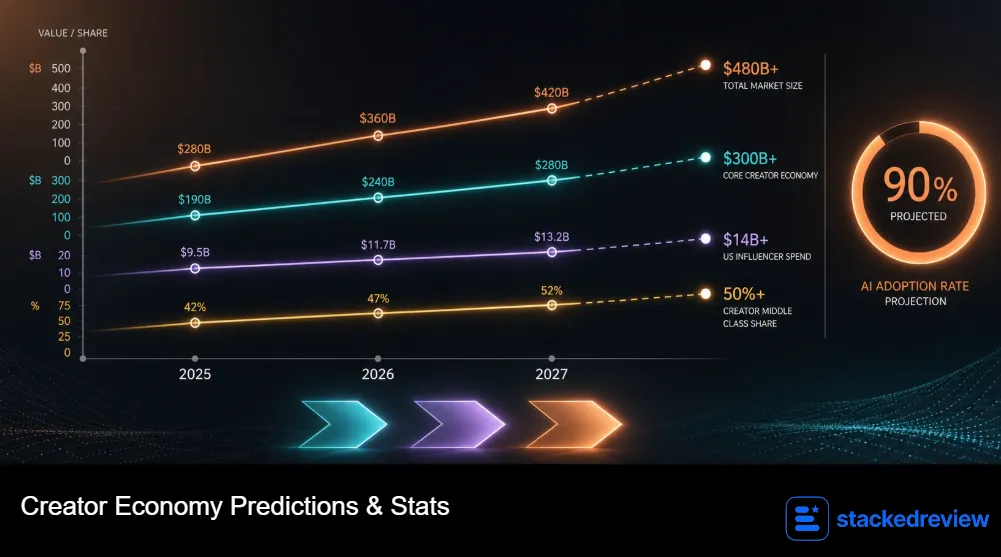
We think the core creator economy market size clears $300 billion by 2027 on the content-monetisation definition. The broad definition blows past $480 billion.
We expect the creator middle class to cross 50% of committed creators by 2027. The middle is filling in, and fast.
On AI, our call is simple. Active-creator adoption tops 90% by the end of 2026. The holdouts get left behind.
These are informed calls, not certainties. But we would bet on every one of them.
The one prediction we feel surest about: The word “influencer” fades and “creator business” takes over. By 2027 the top of this market looks less like sponsored posts and more like small media companies with products, audiences, and equity. Brands that partner accordingly win. Brands still buying one-off shout-outs fall behind.
Creator Economy Statistics 2026: The Numbers That Matter Most
Let us tie it together. These are the data points we would carry into any 2026 planning meeting.
Read them together and one message lands. The creator economy is massive, growing, and wildly uneven. The winners treat it like a business.
If you take one thing from all these numbers, make it this. The market rewards strategy over follower count, and diversification over dependence. That is true for creators building income, and it is true for brands building programmes. Plan around the split, and the data works in your favour.
Creator Economy FAQ: Quick Answers for 2026
How big is the creator economy in 2026?
The core market sits near $250 billion. Broader estimates that include tools and commerce reach $323 billion. Our working figure for planning is $250 billion.
How many creators are there worldwide?
About 207 million people identify as creators in 2026. Roughly 50 million are semi-professional, and only around 2 million earn a full-time living.
How much do creators actually earn?
More than half earn under $15,000 a year. Only about 4% clear $100,000. Established full-timers post a median near $133,000.
What is the biggest creator revenue source?
Brand deals. They account for around 70% of total creator revenue, though diversification is pulling that share down each year.
Which platform pays creators best?
YouTube, by a distance. Its 55% ad revenue share and $100 billion in payouts since 2021 lead the field for direct income.
Is influencer marketing worth it for brands?
On average, yes. Brands earn $5.78 for every $1 spent, and top campaigns return $11 to $18. Measurement remains the main challenge.
How many creators use AI?
Between 84% and 91% in 2026. Top earners use it most, and it cuts production costs by around 70%.
Sources and Further Reading
We cross-checked every figure above against multiple industry datasets. Here are the trusted sources we lean on for creator economy data.
- Statista, Creator Economy Topic Hub
- Goldman Sachs Research, Creator Economy Outlook
- Grand View Research, Creator Economy Market Report
- The Influencer Marketing Factory, 2026 Creator Economy Report
- Influencer Marketing Hub, Creator Earnings Data
- EMARKETER, Creator Marketing FAQ 2026
- DemandSage, Creator Economy Statistics
- Market.us, Creator Economy Market Size
Numbers move fast in this market. We refresh our figures as new reports land, so bookmark this page and check back through 2026.

Affiliate Disclosure: This post may contain some affiliate links, which means we may receive a commission if you purchase something that we recommend at no additional cost for you (none whatsoever!)
Similar Posts



Verification process
Editorial standards
We’re a team of real users — not bots, not press-release copiers. Here’s exactly how we earn your trust on every single post.
We Actually Buy the Products
Every deal on this site is tested with a real purchase using our own accounts. We don’t rely on screenshots sent by vendors or press kits. If we say the discount works, we’ve clicked through checkout ourselves.
No Pay-to-Rank Policy
We never accept payment to feature or rank a deal higher. Affiliate commissions don’t influence our editorial scores — a bad deal stays ranked low regardless of commission size.
Monthly Re-Verification
Pricing changes fast. Our team re-tests every published deal at least once a month and immediately updates or removes any that have expired, changed, or been capped.
Expert Editorial Team
Our writers and editors have collectively spent 40,000+ hours hands-on with digital tools. We know what a fair price looks like — and we call out bad deals even when they’d earn us commissions.
Transparent Scoring Criteria
Every score is calculated from a public rubric: discount value, feature-to-price ratio, redemption ease, plan flexibility, and competitor comparison. No hidden weighting, ever.
Reader Feedback Loop
Thousands of readers report broken deals each month. Our team investigates every report within 24 hours and updates the page the same day a deal stops working.
Jaclyn Donaldson
Jaclyn is a content strategist at StackedReview with a passion for empowering small businesses. She specializes in dissecting social media advertising costs and hunting down the best-value deals. Her goal is to help brands stretch their budget further without compromising on results.